
Skip to content
ASC Pest Control ASC Pest Control Integrated Pest Management & Disinfection
SAPCA Registered HACCP BRCGS FSSC 22000
061 138 3989 Get a Quote
  • Home
  • Areas
    • Areas Gauteng
    • Areas Eastern Cape
  • Compliance
    • Compliance Haccp
    • Compliance Fssc 22000
    • Compliance Audit Documentation
    • Compliance Brcgs
  • Contact
  • Faq
  • Industries
    • Industry Corporate
    • Industry Education
    • Industry Food Beverage
    • Industry Healthcare
    • Industry Hospitality
    • Industry Retail Public
  • Residentshub
  • Signin
  • Services
    • Service Rodent Control
    • Service Termite Control
    • Service Monitoring Audit Support
    • Service Ipm
    • Service Disinfection
    • Service Fly Ant Control
    • Service Cockroach Control
    • Service Bed Bug Control
  • Blog
  • Home
  • Areas
    • Areas Gauteng
    • Areas Eastern Cape
  • Compliance
    • Compliance Haccp
    • Compliance Fssc 22000
    • Compliance Audit Documentation
    • Compliance Brcgs
  • Contact
  • Faq
  • Industries
    • Industry Corporate
    • Industry Education
    • Industry Food Beverage
    • Industry Healthcare
    • Industry Hospitality
    • Industry Retail Public
  • Residentshub
  • Signin
  • Services
    • Service Rodent Control
    • Service Termite Control
    • Service Monitoring Audit Support
    • Service Ipm
    • Service Disinfection
    • Service Fly Ant Control
    • Service Cockroach Control
    • Service Bed Bug Control
  • Blog
Technician using an electrostatic disinfection sprayer in a clinical treatment room

Home/Blog/Hospital-Grade Disinfection
Healthcare

Hospital-Grade Disinfection: What Sets It Apart From Standard Cleaning

ASC

ASC Pest Control Team

15 Jan 2025
6 min read

Standard cleaning removes visible soil and organic material from surfaces. That is what it is designed to do, and in most domestic and office settings it is entirely adequate. Hospital-grade disinfection does something fundamentally different: it achieves a validated reduction in pathogenic microorganisms, bacteria, viruses and fungi, on surfaces to a level that is safe for high-risk environments.

In healthcare facilities, food-processing plants, aged care homes and any setting where vulnerable people or food safety are at stake, the distinction is not academic. A visually clean surface can carry a high microbial load. A disinfected surface has had that load systematically reduced by a verified chemical process.

99.999%
Log-5 reduction, hospital-grade kill claim standard
Dwell time
The most commonly skipped step in DIY disinfection
Electrostatic
Application method that reaches surfaces wiping misses
Certificate
What every professional treatment should provide

Three Differences That Matter

1. The Chemistry

Hospital-grade disinfectants are formulated with active ingredients, quaternary ammonium compounds, hydrogen peroxide, or chlorine dioxide, at concentrations that achieve a quantified microbial kill. They carry a registration number and a product claim (e.g., “kills 99.999% of Staphylococcus aureus, Salmonella and Influenza A“) that has been verified by independent laboratory testing.

Consumer disinfectant sprays may use the same class of chemistry at much lower concentrations, or they may use ingredients that reduce odour and inhibit mould growth without achieving the kill rates required for a clinical setting. If the product label does not state a specific log-reduction claim and list the target organisms, it is not a hospital-grade disinfectant.
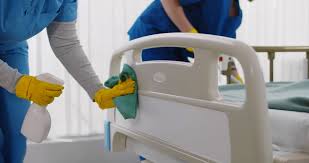
Registered hospital-grade disinfectant products lined up next to safety data sheets on a clinical surface
Hospital-grade disinfectants carry a registration number and a verified kill claim, not just a marketing statement.

2. The Dwell Time

Every disinfectant has a contact time, the minimum period the product must remain wet on the surface to achieve its stated kill claim. For most hospital-grade products this is between 1 and 10 minutes. In practice, surfaces are often wiped immediately after application, which defeats the purpose entirely and achieves a fraction of the claimed reduction.

The most common mistake: Spraying and immediately wiping. The product must remain visibly wet on the surface for the full contact time stated on the label. If the surface dries in 30 seconds, the kill rate is not being achieved regardless of how effective the product is.

3. The Application Method

Manual wiping, even with the correct product at the correct concentration, cannot reach every surface in a room. The undersides of surfaces, the backs of equipment, wall returns and corners, and the inside surfaces of furniture are all missed by a standard wipe-down. Electrostatic sprayers address this by charging the disinfectant droplets, which causes them to wrap around and adhere to all exposed surfaces, including areas that face away from the spray nozzle.
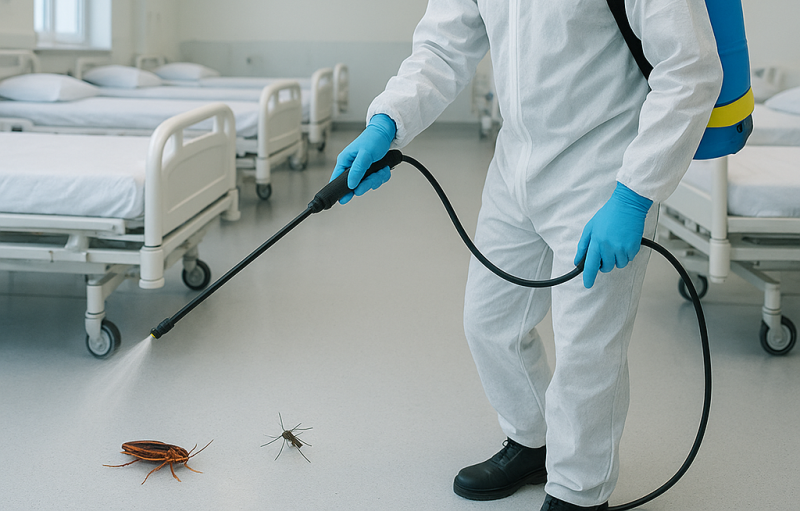
Electrostatic sprayer nozzle demonstrating wrap-around coverage on the underside of a clinical shelf
Electrostatic application achieves uniform surface coverage including undersides and hard-to-reach areas that wipe methods consistently miss.

When You Need Hospital-Grade Disinfection

  • Healthcare facilities, any facility where clinical care is provided, including private clinics, dental practices, physiotherapy rooms and veterinary practices.
  • Aged care and frail care homes, where residents have reduced immunity and the consequences of pathogen exposure are severe.
  • Food-processing and food-packaging plants, where surface contamination directly translates to product contamination and compliance failure.
  • Post-outbreak remediation, following a confirmed or suspected outbreak of gastroenteritis, COVID-19, influenza or any notifiable condition in a workplace or public facility.
  • High-traffic commercial spaces, hospitality venues, gyms, childcare facilities and shopping-centre common areas benefit from periodic validated disinfection treatments.

What ASC’s Disinfection Service Delivers

ASC Pest Control’s hospital-grade disinfection service uses registered disinfectants with verified kill claims, applied by electrostatic sprayer at the correct dilution and contact time. Every treatment is followed by a written certificate of treatment that records: the facility, date, areas treated, products used (with registration numbers), dilution rates, application method, and technician details.

Covered areas: Disinfection services are available across Gqeberha, Nelson Mandela Bay, the Eastern Cape and Gauteng. Emergency post-outbreak response is available with 24-hour mobilisation.

Book a disinfection treatment

Get a written certificate of treatment with every service. Call 061 138 3989 or submit a request online and our team will respond within 4 business hours.

Request a Disinfection Quote
Call 061 138 3989

DisinfectionHealthcareFood SafetyElectrostaticPathogen Control
Share:WhatsAppLinkedIn
ASC

ASC Pest Control Team, Gqeberha

Providing hospital-grade disinfection services to healthcare facilities, food processors, hospitality venues and commercial premises across Nelson Mandela Bay and the Eastern Cape.

Related Articles

Image
Food facility · audit documentation
800 × 450 px
Compliance

What HACCP Requires From Your Pest Control Provider

Image
IPM monitoring station · inspection
800 × 450 px
IPM

Integrated Pest Management Explained

Image
Commercial kitchen · food service
800 × 450 px
Commercial

Why Restaurants Fail Cockroach Inspections


ASC Pest Control ASC Pest Control

Compliance-driven pest control and hospital-grade disinfection across Gqeberha, the Eastern Cape and Gauteng.

Member SAPCA
Follow us

Company

  • About
  • Services
  • Compliance
  • Contact

Services

  • Integrated Pest Management
  • Cockroach Control
  • Rodent Control
  • Disinfection
  • Blog

Get in touch

  • 061 138 3989
  • WhatsApp Us
  • info@ascpestcontrol.co.za
  • Gqeberha, Eastern Cape, South Africa
© ASC Pest Control Services. All rights reserved. Gqeberha · Nelson Mandela Bay · Eastern Cape & Gauteng
  • Home
  • Areas
    • Areas Gauteng
    • Areas Eastern Cape
  • Compliance
    • Compliance Haccp
    • Compliance Fssc 22000
    • Compliance Audit Documentation
    • Compliance Brcgs
  • Contact
  • Faq
  • Industries
    • Industry Corporate
    • Industry Education
    • Industry Food Beverage
    • Industry Healthcare
    • Industry Hospitality
    • Industry Retail Public
  • Residentshub
  • Signin
  • Services
    • Service Rodent Control
    • Service Termite Control
    • Service Monitoring Audit Support
    • Service Ipm
    • Service Disinfection
    • Service Fly Ant Control
    • Service Cockroach Control
    • Service Bed Bug Control
  • Blog
  • Home
  • Areas
    • Areas Gauteng
    • Areas Eastern Cape
  • Compliance
    • Compliance Haccp
    • Compliance Fssc 22000
    • Compliance Audit Documentation
    • Compliance Brcgs
  • Contact
  • Faq
  • Industries
    • Industry Corporate
    • Industry Education
    • Industry Food Beverage
    • Industry Healthcare
    • Industry Hospitality
    • Industry Retail Public
  • Residentshub
  • Signin
  • Services
    • Service Rodent Control
    • Service Termite Control
    • Service Monitoring Audit Support
    • Service Ipm
    • Service Disinfection
    • Service Fly Ant Control
    • Service Cockroach Control
    • Service Bed Bug Control
  • Blog