
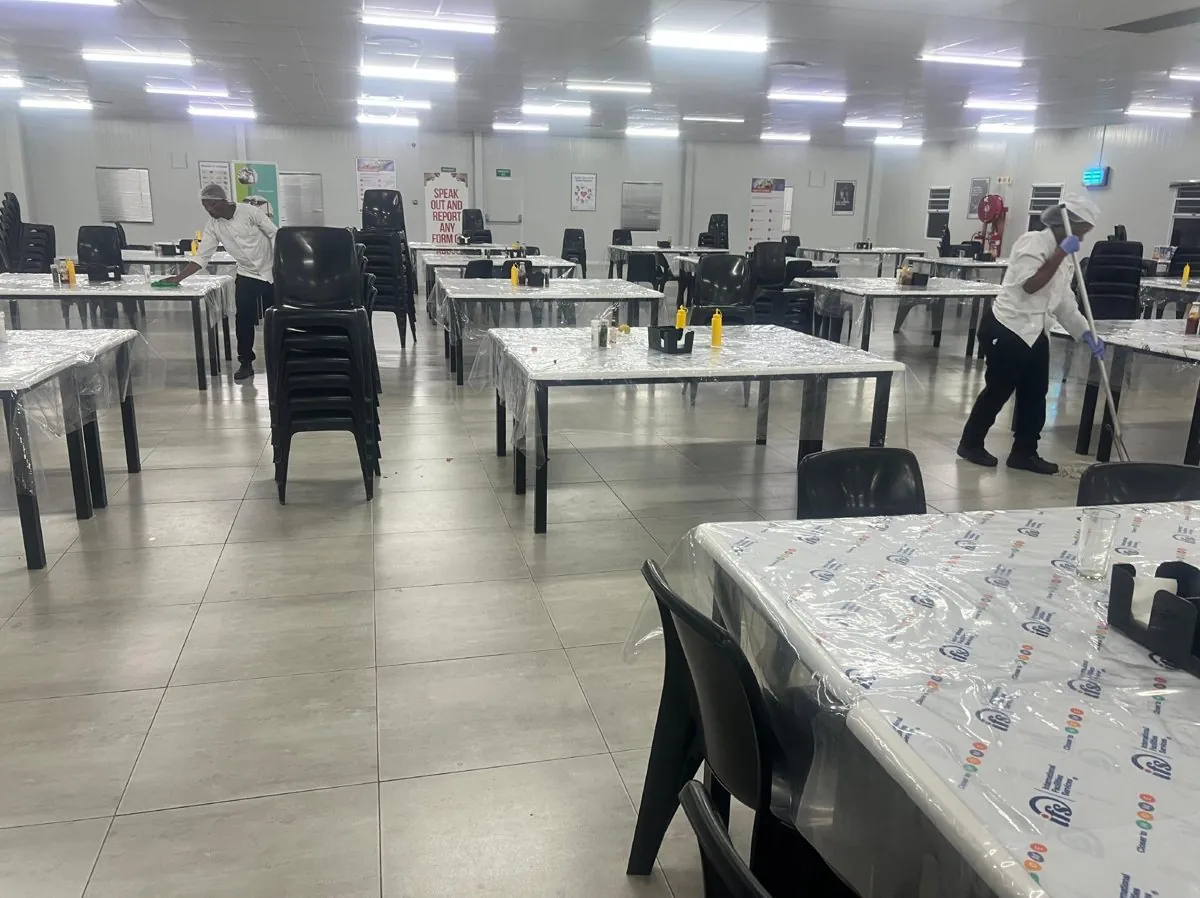
A staff canteen, a mine or camp kitchen and a large catering operation share one defining feature: scale. One kitchen feeds hundreds or thousands of the same people, day after day, often across breakfast, lunch and supper. That scale is precisely what makes a pathogen alert in such a kitchen so serious. When environmental monitoring flags Salmonella or E. coli, the maths are unforgiving: a single contamination reservoir that reaches the food can turn a routine service into a workforce-wide outbreak in one sitting. A staff canteen sits at the heart of our office and corporate pest control programmes.
High throughput is a double-edged sword. It delivers efficiency, but it also generates exactly the warm, wet, food-soiled conditions that Salmonella and E. coli exploit, and it leaves little downtime for the deep cleaning those conditions demand. This article explains why a pathogen alert in a canteen or industrial kitchen calls for a food-safety-led deep clean rather than an overnight wipe, where the organisms actually hide, and how the ASC model finds the reservoir, destroys it and proves it is gone.
Key takeaways
- Canteens and camp kitchens feed large populations from one kitchen, so a single Salmonella or E. coli reservoir can cause a large, fast outbreak. The stakes justify a verified deep clean, not a routine wipe.
- The organisms hide in warm, wet areas: the dishwash zone, floor drains, table seams, can-opener and mixer attachments, and standing water. These Zone 3 and Zone 4 niches survive routine cleaning.
- The ASC model splits the science from the labour: consultants run environmental monitoring, risk assessment and microbiological recommendations, then the disinfection division deep cleans the dishwash and drain harbourage with food-grade chemistry.
- A food safety specialist should lead the work. Pre and post verification swabbing, tracking the pathogen and the Enterobacteriaceae indicator family across the zones, proves the kitchen is safe to reopen.
Why scale turns a positive into an emergency
In a small restaurant, a lapse might make a handful of customers unwell. In a canteen serving a three-thousand-strong mine or a boarding institution, the same lapse can put an entire population at risk in a single meal. Salmonella and E. coli are the organisms most associated with these high-volume outbreaks. Salmonella arrives with raw ingredients, especially poultry, eggs and raw meat, and spreads through cross-contamination and inadequately cleaned equipment. E. coli is both a cause of illness and a faecal and hygiene indicator, signalling where cleaning and separation have broken down. The same risk drives our hospitality and restaurant pest control programmes.
Two features of high-throughput kitchens amplify the danger. First, the food is prepared in bulk and held or served warm, so a small contamination can be multiplied across a huge batch. Second, the population is captive and homogeneous: the same workforce eats from the same servery, so an outbreak is not diluted across the general public but concentrated in one organisation. That is why a positive result in a canteen is not a housekeeping issue to note and defer. It is a food safety event that must be closed out with a verified deep clean before the next service.
The warm, wet hotspots where they hide
Finding Salmonella and E. coli in a busy kitchen means going where it is warm, wet and rarely dismantled. The reservoirs are consistent.
- The dishwash zone. The single biggest reservoir. The machine sump, wash tank, spray arms, curtains and the surrounding splash zone stay warm and wet all day and collect a constant load of food soil. The drains beneath the dishwasher are a classic harbourage.
- Floor drains and gullies. Warm, wet and nutrient-rich, and rarely lifted and scrubbed properly.
- Prep table seams and undersides. Welds, joins and the hidden underside of surfaces trap moisture and residue out of sight.
- Equipment attachments. Can-opener blades, mixer hubs and beaters, slicer guards and bain-marie wells collect food debris in awkward crevices.
- Standing water. Pooled water under equipment, in mop sinks and in blocked gullies is a ready reservoir.
Every one of these is a Zone 3 or Zone 4 site, part of the environment rather than a visible food-contact surface, and every one survives the routine end-of-shift clean that a busy kitchen has time for. That is why a positive calls for a deep clean that opens these niches up, not a faster mop.
Why a food safety specialist must lead
There is an important distinction between making a kitchen look clean and making it verifiably safe. A general cleaning contractor is good at the first. Closing out a pathogen alert requires the second, and that is a microbiological exercise, not a mopping one.
A food-safety-led response is directed by evidence. It uses environmental monitoring and risk assessment to trace the positive to its actual source, applies the correct food-grade chemistry at validated contact times, targets the dishwash and drain reservoirs that generic cleaning misses, and proves the result with swabs. Get any of that wrong, use the wrong chemical, skip the drains, cut the contact time short, and the reservoir stays in place ready to seed the next outbreak, while the kitchen looks perfectly clean. This is exactly why the ASC model puts qualified food safety consultants in charge of the diagnosis and verification, with a trained disinfection division doing the physical work to their specification.
The deep clean protocol
An ASC corrective disinfection of a canteen or industrial kitchen is planned into a closure or extended overnight window so the harbourage can genuinely be reached, and it follows a strict sequence. This planned, sequenced work is exactly what our disinfection services deliver.
- Strip the dishwash and expose harbourage. Dismantle the dishwasher sump, spray arms and tank, lift drain covers, and open equipment attachments identified in the swab map.
- Food-grade detergent. Apply an alkaline detergent to lift grease, starch and protein soil that would otherwise neutralise the disinfectant and shield bacteria.
- Mechanical cleaning. Scrub sumps, drains, table seams and attachments. Physical action is what removes biofilm and embedded soil.
- Rinse. Clear loosened soil and detergent from all surfaces.
- Food-grade disinfectant at full contact time. Apply a disinfectant proven against Salmonella and E. coli, honouring the label contact time on every target surface. Only food-grade, food-safe chemistry is used, never industrial or unlabelled products in a food space.
- Dishwash and drain focus. Give the dishwasher internals, the drains beneath it, and all floor gullies dedicated treatment, with a residual drain product where recommended.
- Dry, verify, reopen. Allow drying, take post-cleaning verification swabs, and reopen only once the results confirm the reservoir is gone.
Verification and the indicator family
A kitchen is safe to reopen when the swabs say so. ASC uses paired swabbing: pre-cleaning swabs to locate the organism and set the baseline, and post-cleaning verification swabs from the dishwash internals, drains, table seams, equipment attachments and other risk points once the kitchen has dried. A negative for Salmonella or E. coli at those sites is the primary proof.
Alongside the pathogen result, ASC tracks the Enterobacteriaceae indicator family, which includes both Salmonella and E. coli and is the standard hygiene indicator for a kitchen. A low and stable count across the zones confirms that general hygiene has genuinely been reset, not just that one organism was removed from one point. Together, a clear pathogen result and a low indicator count give the operator defensible evidence that the kitchen is safe to feed its population again, exactly the evidence a client, an occupational health team or an Environmental Health Practitioner will want to see after an alert.
Risk-based monitoring frequency
ASC sets swabbing frequency with a probability by severity risk matrix, which fits high-throughput catering well. Probability reflects history, throughput, the age and design of the dishwash and drainage, and previous results. Severity reflects the population at stake: a kitchen serving thousands of workers or a remote camp with limited medical backup carries very high severity, because an outbreak there is both large and hard to manage. A high-volume kitchen with a recent Salmonella history and an ageing dishwasher sits high on both axes and earns frequent, intensive verification, while a smaller, well-run operation with a clean record can be monitored less often. The matrix keeps the programme proportionate and focuses the heaviest scrutiny where an outbreak would affect the most people.
Frequently asked questions
Why is a pathogen positive in a canteen so high-risk?
A staff canteen, camp kitchen or catering operation feeds hundreds or thousands of the same people from one kitchen, often several times a day. High throughput means high exposure: a single Salmonella or E. coli reservoir that recontaminates food can become a large outbreak very quickly, affecting an entire workforce or site in one sitting. That scale is why a positive must be closed out with a verified deep clean.
Where do Salmonella and E. coli hide in a high-throughput kitchen?
In the warm, wet, hard-to-clean areas. The dishwash zone is the classic reservoir: the sump, spray arms, wash tank, splash zones and the drains beneath it stay warm and wet all day and collect food soil. Other hotspots are floor drains, prep table seams and undersides, can-opener and mixer attachments, and standing water. These Zone 3 and Zone 4 niches survive routine cleaning and reseed the surfaces staff use.
Why should a food safety specialist lead the deep clean rather than a general cleaner?
A general cleaner makes a kitchen look clean; a food safety specialist makes it verifiably safe. After a positive the work must be directed by monitoring to the exact harbourage, use the right food-grade chemistry at validated contact times, target the dishwash and drain reservoirs generic cleaning misses, and be proven by pre and post swabbing. That is a microbiological exercise, and getting it wrong leaves the reservoir in place.
How quickly can a canteen reopen after a deep clean?
Most kitchens can be deep cleaned overnight or over a planned closure, since the space is compact. The gate is verification: ASC reopens the kitchen only once post-cleaning swab results confirm the reservoir is cleared. The results decide the timing, not the clock, which protects the population the kitchen feeds.
Are the chemicals safe to use in a working food kitchen?
Yes. ASC uses only food-grade, food-safe detergents and disinfectants, selected by the consultants for the surface and soil load, applied at label concentrations and rinsed correctly. Industrial or unlabelled products are never used in a food space. Treating chemical selection with the same rigour as a food processing plant is central to the food-safety-led approach.