
High-Hazard / Space & Commodity Treatment
Fumigation and fogging, used only when the situation calls for it.
Space fumigation, ULV fogging and commodity or container fumigation clear infestations that targeted work cannot reach. They are also the most hazardous tools in pest control, so we deploy them with care: registered products, a safety method statement, monitoring, clear re-entry times and a documented clearance every time.
Why It Matters
Some infestations hide where a bait station or a spray simply cannot reach.
Stored product insects burrow deep inside grain, pulses, nuts, dried fruit and packaging, breeding unseen through an entire consignment. Cockroaches and flying insects colonise the voids, racking and roof spaces of a large warehouse where surface treatment barely scratches the surface. And an export commodity or shipping container may need to be treated as a whole before it can legally cross a border. In these situations a treatment that fills the space or penetrates the commodity is the only method that reaches every insect and every egg. Fumigation and fogging do exactly that, which is why they are indispensable, and exactly why they demand a registered specialist rather than a general operator.
Deep infestations
Stored product insects live inside the commodity, not on it. Only a penetrating treatment reaches larvae and eggs buried through a bulk stack of grain, pulses or dried goods.
Large volumes
A high-bay warehouse or full container is too big to treat surface by surface. A controlled space or commodity treatment reaches the whole volume at once.
Export and quarantine
Consignments and containers often require documented commodity fumigation to satisfy phytosanitary and quarantine requirements before shipping or on arrival.
Safety and legality
Fumigants are among the most hazardous substances in the trade. Done wrong they endanger life; done right, under Act 36 of 1947, they are safe and effective.
Know The Signs
How do you know you need fumigation, not just a spray?
Fumigation is the right tool when live insects are found inside sealed packaging or deep in bulk stock, when small emergence holes or webbing appear through grain, seed or dried goods, when a musty or sour smell develops in a bulk store, or when a consignment must be certified pest-free to clear export, import or quarantine inspection. If the infestation is on the surface of a small area, targeted pest control is usually enough; if it is inside the commodity itself or spread through a large enclosed space, only a penetrating treatment reaches it.
Insects inside sealed packaging
Live weevils, beetles or moths found inside sealed bags or boxes mean the infestation started before or during packaging and is already inside the commodity.
Emergence holes & webbing
Small round holes through grain, seed, nuts or dried fruit, or silk webbing binding product together, are signs of stored product insects breeding through the stack.
Musty or sour odour
An unusual smell developing in a bulk store or silo, distinct from normal product odour, often signals insect activity and heat building inside the stack.
Failed export or quarantine inspection
A consignment flagged at inspection for live insects needs a certified fumigation and clearance before it can be re-presented for shipping or import.
Not sure which situation you are in? Call 041 004 0037 or request an assessment and we will confirm whether targeted IPM or fumigation is the right, proportionate treatment — we do not recommend fumigation unless the situation genuinely calls for it.
In The Field
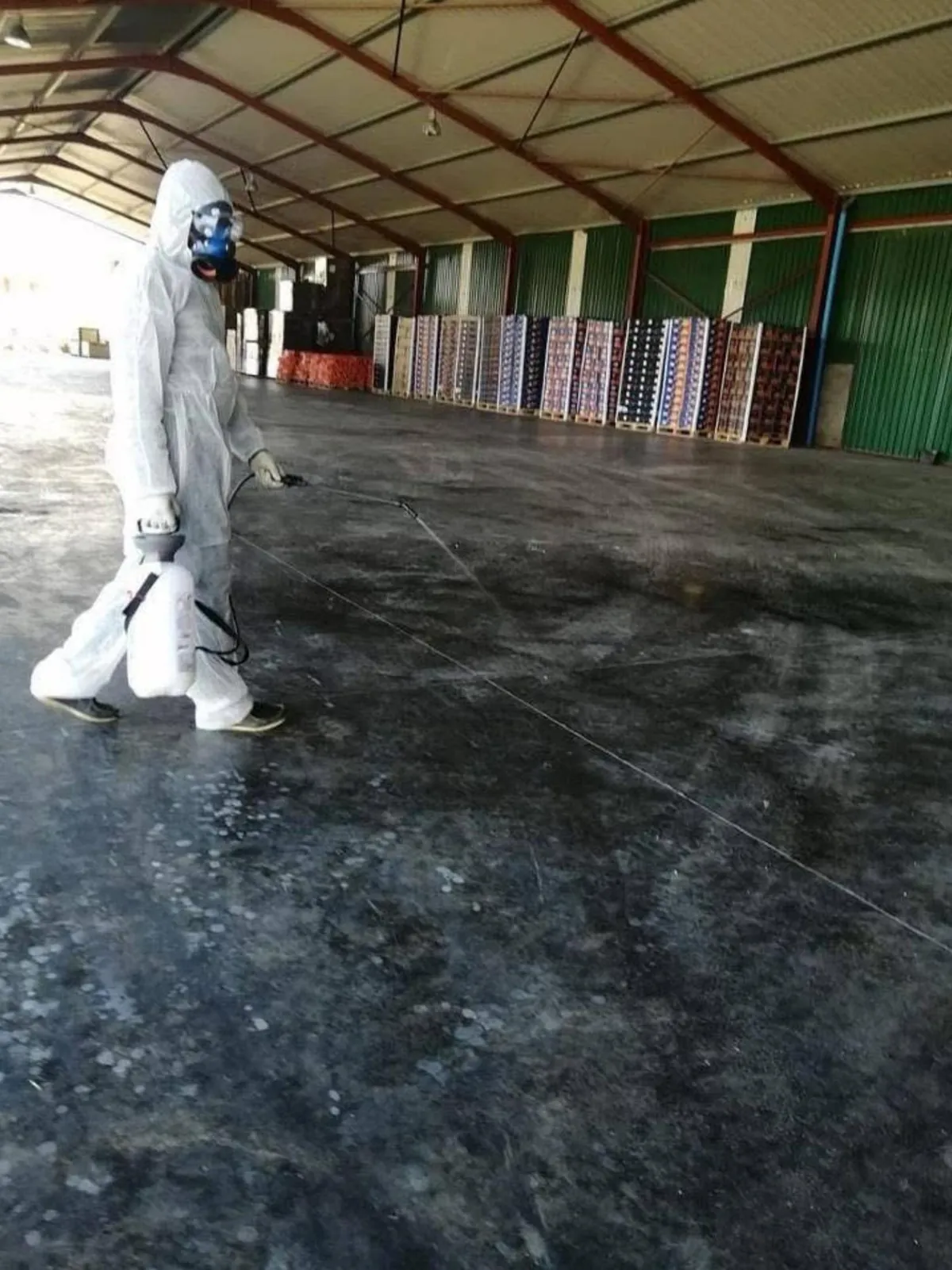
What We Do
Three treatments, each matched to the job.
Space fumigation
A registered fumigant is introduced into a sealed space, held for a controlled exposure period so the gas penetrates cracks, voids and stacked goods, then fully ventilated and monitored until the atmosphere reads safe. Used for heavy, widespread infestations of empty warehouses, stores and structures.
ULV fogging
Ultra-low-volume fogging disperses a fine mist of registered insecticide that stays airborne and settles into the space, knocking down flying and exposed crawling insects across a large volume quickly. Ideal as a periodic reset in warehouses and production areas, followed by targeted control.
Commodity and container fumigation
Bulk commodities, stacked goods and shipping containers fumigated under sheeting or in a sealed unit to clear stored product insects through the whole consignment, with documentation to support export, import and quarantine requirements.
Export manufacturers who ship on a regular cycle do not book this job by job. We build container and stack fumigation into a contract pest control agreement, so every consignment is fumigated, certified and documented on schedule without a new quote each time.
The Honest Answer
Fumigation is a tool, not a routine. IPM comes first.
A pest company that reaches for the fumigant every month is doing it wrong. Fumigation and fogging are corrective, high-hazard interventions, not a substitute for preventing pests in the first place. As food safety specialists, our default is Integrated Pest Management: seal the building, monitor the risk, keep the commodity moving and treat precisely where a problem appears. We recommend fumigation or fogging only when the situation genuinely warrants it, and we tell you plainly when it does not. That honesty protects your product, your people, your budget and the environment.
Reach for fumigation or fogging when
- ✓ A commodity or container must be treated before export or import
- ✓ Stored product insects have spread through a bulk stack
- ✓ An empty structure is heavily infested and needs a reset
Stay with targeted IPM when
- ✓ The problem is localised and can be reached directly
- ✓ The space is occupied and running day to day
- ✓ Prevention and exclusion can close the problem off at source
Read: how Integrated Pest Management puts prevention first →
Safety First
How we keep fumigation and fogging safe.
Fumigants and fogging agents are high-hazard substances, and every death or injury reported from misuse in South Africa is a reminder of what happens when they are handled by untrained hands. We treat safety as the first deliverable, not an afterthought.
Registered operators only
Every fumigation and fogging job is carried out by registered pest control operators trained in these methods, using products registered under Act 36 of 1947 for the exact use.
Method statement and signage
A written safety method statement, hazard notices, sealed access, warning signage and controlled entry for the full treatment window. The area is locked down for people while it is under gas.
Monitoring and clearance
Forced ventilation and atmospheric monitoring after exposure. The space is only released, in writing, once readings confirm it is safe to re-enter.
Documented re-entry times
Clear, written re-entry times given before the work starts, so your team knows exactly when the space, commodity or container is theirs again.
Read: what Act 36 of 1947 requires of every product and operator →
The ASC Difference
Public-health specialists who respect the power of the tool.
Fumigation and fogging are the sharpest instruments in pest control, and they belong in the hands of people who understand both the chemistry and the consequences. ASC is a food safety specialist owned pest control company. We audit and inspect facilities for a living, so we plan every high-hazard treatment the way an auditor would want to see it: justified, method-stated, monitored, cleared and recorded. Care for the impact of chemicals on people, product and the environment is not a slogan for us, it is why we insist on IPM first and reserve fumigation for where nothing else will do.
Every job is captured in the My ASC Pest Hub portal: the method statement, the product register, monitoring readings, the clearance and the re-entry time, all in one place. When a customer, an auditor or an export authority asks for proof, you generate a complete pack in one click and see trends across every site you run.
- ✓ SAPCA member ASC797, registered PCOs under Act 36 of 1947
- ✓ Structural Pest Control registration P43510
- ✓ IPM first, fumigation only where it is genuinely warranted
- ✓ Method statements, monitoring and clearance packs via My ASC Pest Hub

Credentials
Registered, accredited and trained to a food safety standard.
High-hazard treatments demand high-standard people. Our team is trained well beyond the minimum required of a pest control operator, in the same food safety and auditing disciplines that protect the facilities we serve.
Where we do this
Fumigation and fogging across Gqeberha and Johannesburg
We fumigate and fog commodities, structures and enclosed spaces in Port Elizabeth (Gqeberha) — including packhouses, cold stores and export consignments moving through the Coega IDZ — and across Johannesburg's distribution belt at City Deep, Isando, Longmeadow and Wadeville. Every treatment is notified, sealed, monitored and cleared before re-entry, with the paperwork to prove it.
Nelson Mandela Bay: South End, Newton Park, Walmer, Summerstrand, Humewood, North End, Korsten, Deal Party, Struandale, Perseverance, Markman, Coega IDZ, Kariega (Uitenhage), Despatch.
Greater Johannesburg: Sandton, Randburg, Rosebank, Midrand, Fourways, Roodepoort, Soweto, Edenvale, Bedfordview, Germiston, Alberton, Boksburg, Benoni, Kempton Park, plus City Deep, Isando, Longmeadow, Linbro Park, Wadeville and Alrode.
Pest control in Port Elizabeth (Gqeberha) · Pest control in Johannesburg · East London · Eastern Cape · Gauteng
Questions
Fumigation and fogging FAQ
When is fumigation appropriate versus targeted pest control?
Fumigation and space fogging are powerful tools reserved for specific situations: a widespread stored product insect infestation through a bulk commodity, a container or consignment that must be treated before export or import, or a heavily infested empty space that targeted work cannot reach. For day-to-day pest pressure, Integrated Pest Management, meaning prevention, exclusion, monitoring and targeted treatment, is safer, cheaper and more sustainable. ASC only recommends fumigation or fogging where the situation genuinely calls for it, never as a routine replacement for good IPM.
How long before a fumigated or fogged area is safe to re-enter?
Re-entry time depends on the product used, the treatment type and the space. A fumigation is followed by a controlled exposure period and then forced ventilation and gas monitoring until the atmosphere reads safe, and the area is only released when clearance is confirmed. ULV fogging generally requires a shorter closed period followed by ventilation. Your specialist gives the exact re-entry time in writing before the work starts, and no one enters until the space is cleared.
Are your fumigation and fogging products legal and registered?
Yes. Every product we use for fumigation and fogging is registered under Act 36 of 1947 for the exact target and use, and is applied only by registered pest control operators trained in these high-hazard methods. ASC is a SAPCA member (ASC797) with structural pest control registration P43510, and every treatment is planned with a safety method statement, signage, monitoring and a documented clearance recorded in the My ASC Pest Hub portal.
Can you fumigate export commodities and shipping containers?
Yes. We carry out commodity and container fumigation for stored product insects, with the documentation needed to support export, import and quarantine requirements. We plan the treatment around your loading schedule so the consignment is cleared and released on time.
Do I have to leave the building during fumigation?
For space fumigation, yes: the treated area is sealed and no person may be inside for the exposure and ventilation period, and it is only released once monitoring confirms it is safe. ULV fogging of an occupied facility is scheduled around operations with a defined closed and re-entry window. Your specialist confirms exactly what is required before the job.
How much does fumigation cost in South Africa?
Cost depends on the treatment type (space fumigation, ULV fogging or commodity/container fumigation), the volume being treated, the fumigant required and how the space needs to be sealed and monitored. Export container fumigation is priced differently from a warehouse fog. We quote after understanding the volume, the target pest and the timeline, particularly for export work booked around a shipping schedule.
Is fumigation safe for food-grade warehouses and factories?
Yes, when carried out correctly by a registered operator. Every fumigant is registered under Act 36 of 1947 for the specific target and setting, applied under a written safety method statement, and the space is only released for food production or storage once gas monitoring confirms the atmosphere is clear. Fumigation is planned around your production schedule so cleared areas can return to use without residue risk.
How do I know if I need fumigation or just standard pest control?
If the pests are visible on surfaces, in a defined area, or respond to targeted baiting and monitoring, standard Integrated Pest Management is the safer, cheaper, more sustainable answer. Fumigation is reserved for infestations inside a commodity itself, spread through a large enclosed space that surface treatment cannot reach, or where a certified pest-free consignment is required for export. We assess the situation on site rather than defaulting to the most aggressive treatment.
Next Step
Book a fumigation and fogging assessment.
A registered specialist will assess the space, commodity or container, confirm whether fumigation or fogging is the right call, and plan a safe, documented treatment with clear re-entry times.