
Commercial / Manufacturing
Structural pest control for factories that protects the building and the stock.
In packaging, printing, plastics and textiles, pests do not just contaminate, they cause damage. Rodents gnaw cabling and panels, textile pests destroy natural-fibre stock, and stored product insects infest paper, board and packaging. ASC Pest Control designs structural Integrated Pest Management around your loading bays, stored materials and production areas, so your building, your raw materials and your finished goods stay protected.
Why It Matters
In manufacturing, pests damage assets, stock and output, not just hygiene.
Non-food factories rarely think of themselves as pest-prone, but they are ideal habitat. Large structures with countless voids, warm machinery, quiet racking and constant vehicle movement through loading bays give rodents, birds and insects easy entry and endless harbourage. Raw materials such as paper, board, cardboard, natural fibres, starches and adhesives are food and nesting material. The cost here is measured in damaged stock, contaminated finished goods, gnawed cabling, fire risk from chewed insulation, unplanned downtime and rejected deliveries. For any manufacturer supplying retailers or holding ISO certification, a pest incident is also a supplier non-conformance that can jeopardise the contract.
Structural damage
Rodents gnaw cabling, insulation, control panels and machinery, causing electrical fire risk, breakdowns and expensive unplanned downtime.
Stock & material loss
Textile pests destroy natural-fibre stock and stored product insects infest paper, board and packaging, turning saleable stock into waste.
Contaminated finished goods
Insects, droppings and webbing in finished product or packaging trigger customer rejections, returns and reputational damage.
Supplier compliance
Retailer supplier standards and ISO 9001 and ISO 14001 systems expect documented pest management. A weak programme is a non-conformance.
Structural Integrated Pest Management
Protecting the fabric of the building, and everything stored inside it.
Structural IPM treats the factory as a system: keep pests out of the shell, remove harbourage inside, and monitor continuously so pressure never builds. Prevention and exclusion do most of the work, which keeps any chemical use minimal, targeted and well away from staff and stock.
Perimeter & exclusion
Sealing the building envelope: doors, dock seals, services, drains and wall penetrations, so pests are kept out physically.
Rodent monitoring
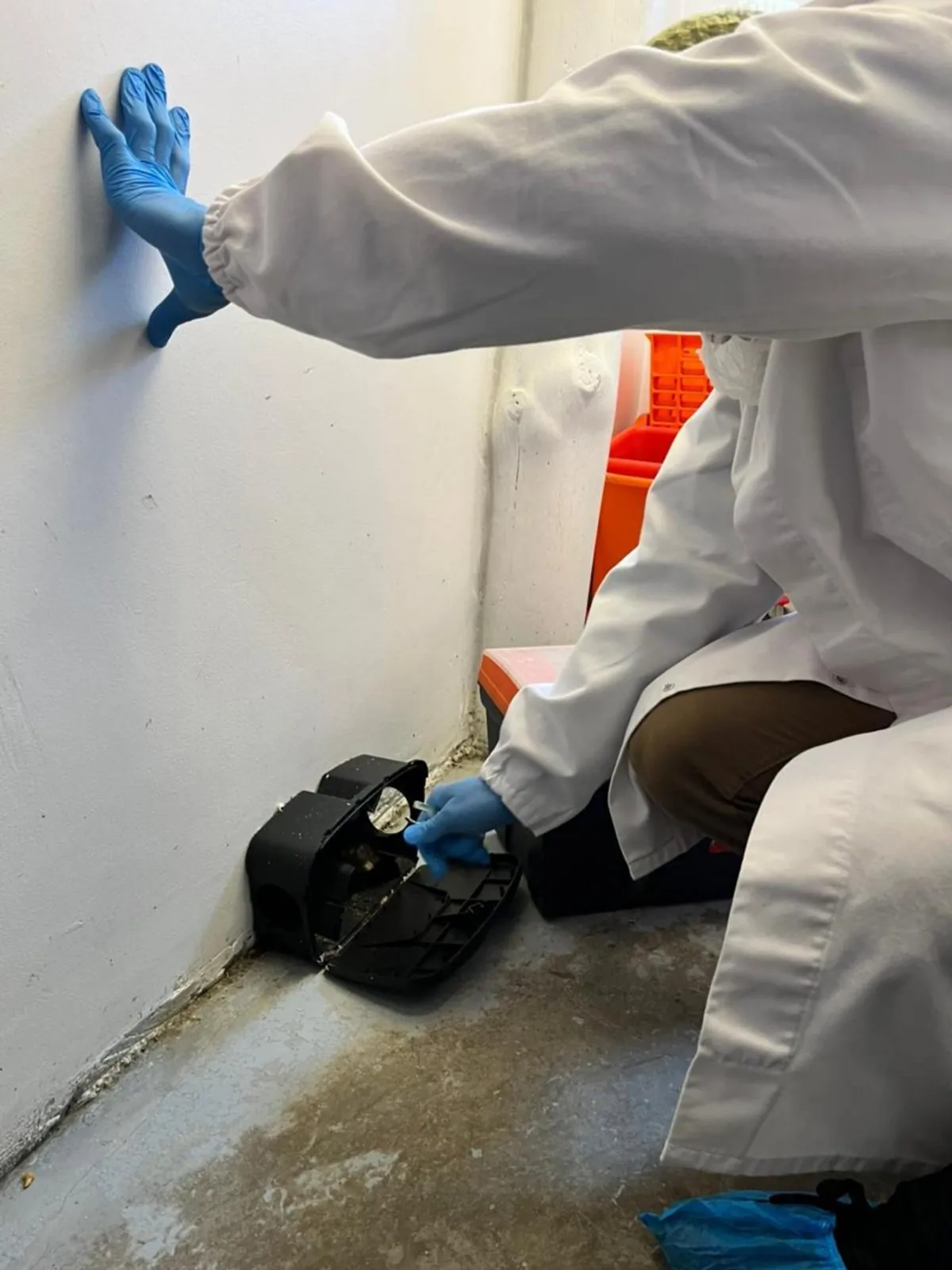
Mapped, tamper-resistant stations at the perimeter and internal travel routes, protecting cabling, panels and machinery.
Insect light traps
ILTs positioned to intercept flying insects at bays and production areas, with catch identification and trending.
Pheromone monitoring
Species-specific monitoring for clothes moths, carpet beetles and stored product insects that damage textiles, paper and board.
Bird management
Proofing and deterrence at high-bay racking, loading bays and roof voids to stop fouling of finished stock.
Targeted treatment
Where a product is needed, it is registered, low-toxicity and precisely applied, never a routine broadcast spray.
Stored Materials & Loading Bays
The two places where most factory infestations begin.
Almost every manufacturing pest problem starts in one of two places: the loading bay, where pests walk, fly or ride in, or the stored materials, where they settle and breed. We concentrate on both. Loading bays are proofed and monitored as the primary entry point, with door seals, dock levellers, strip curtains and drain covers keeping the shell tight. Stored raw materials and finished stock are protected with stock rotation, clear ground clearance for inspection, incoming pallet checks and species-specific monitoring, so an infestation is caught in a monitor long before it reaches product. This is the difference between structural prevention and reactive spraying.
| Risk area | How ASC protects it |
|---|---|
| Loading & despatch bays | Door and dock proofing, strip curtains, drain covers, perimeter rodent monitoring and incoming pallet inspection. |
| Raw material stores | Stock rotation, ground clearance for inspection, and pheromone or ILT monitoring for stored product and textile pests. |
| Finished goods warehousing | High-bay bird proofing, mapped monitoring in racking and clean-as-you-go discipline to protect saleable stock. |
| Production floor & plant | Rodent protection around cabling, panels and machinery voids, with ILT interception of flying insects. |
| Waste & external areas | Bin-area hygiene, drainage checks and external perimeter control to reduce pressure before it reaches the building. |
Know The Signs
Five signs pests are already inside your factory.
In a non-food factory, watch for gnawed cabling, insulation or control panel wiring, holes or webbing through stored paper, board or natural-fibre stock, droppings or nesting material in racking and voids, bird fouling on finished goods or loading bays, and stock rejected by a customer or auditor for contamination that traces back to pests rather than the production process. Because these buildings are large with countless voids, damage is often found by accident during maintenance rather than during a routine walk.
Gnawed cabling or panels
Chewed insulation, wiring or control panel components found during maintenance are a fire risk signature of rodents that have been present for some time.
Holes or webbing in stock
Small holes through paper, board or packaging, or webbing binding natural-fibre stock together, point to textile pests or stored product insects breeding in long-dwell material.
Droppings or nesting in racking
Found in high racking or quiet voids during a stock take, these are signs of an established population using the height and quiet of the warehouse to go unnoticed.
Bird fouling on goods or bays
Droppings on finished goods, pallets or loading bay surfaces mean birds have established a roost somewhere in the roof steel above.
Customer or auditor rejection
Stock rejected for contamination that does not trace to the production process itself often traces back to an undetected pest source in storage.
Found any of these during a maintenance walk or stock take? Call 041 004 0037 or request a site assessment before it reaches finished goods.
My ASC Pest Hub
Compliance evidence your customers and auditors expect.
If you supply retailers or hold ISO certification, your pest management has to be documented, trended and audit-ready. Every ASC visit is captured digitally in My ASC Pest Hub at hub.ascpestcontrol.co.za. You get live trend graphs by zone that reveal a building problem before it becomes a stock problem, a numbered device map, an approved chemical register with safety data sheets, and every corrective action closed out with evidence. When a customer audit or ISO assessor asks for your pest records, you generate a complete audit pack in one click.
- ✓ Live trend graphs by zone catch pressure early
- ✓ One-click audit packs for customer and ISO audits
- ✓ Numbered device map across bays, stores and plant
- ✓ Corrective actions with root-cause close-out
Why A Public-Health Specialist
Auditor-grade discipline, applied to your factory.
ASC Pest Control is South Africa's only food safety and public-health specialist owned pest control company. We audit regulated facilities for a living, and that structural, evidence-based mindset is exactly what non-food manufacturing needs. Instead of a monthly spray, you get a HACCP-designed, risk-assessed programme with clear zoning, a numbered device map, defined action thresholds, trend analysis and closed-loop corrective actions. Our care for the impact of chemicals on your people, your product and the environment means least-toxic IPM with only registered products applied by registered PCOs. That diligence protects your stock, your customers and your certification. For food-contact packaging or any operation touching the food chain, we align seamlessly with your food and beverage compliance requirements.
Contract Pest Control
Contract pest control for factories, plants and industrial groups.
Structural IPM only works as a continuous programme, which is why manufacturers run it as contract pest control: an annual agreement with a fixed service calendar, mapped monitoring, defined response times and a compliance file your customers and ISO assessors can read at any time. For industrial groups we build multi-site and group contracts that hold every plant, warehouse and branch to one documented standard, with consolidated reporting across the portfolio on My ASC Pest Hub.
Credentials You Can Verify
Registered, accredited and accountable, on every site visit.
How Our Team Is Trained
Specialists trained in the standards that define a compliant operation.
Our operators are trained in the food safety and public-health management systems that govern the most demanding facilities, which means your factory gets structural pest control designed and documented to an auditable standard, not just a routine spray.
Manufacturing We Protect
Every material and process has its own pest pressure.
Packaging
Paper, board and film converting where stored product insects and rodents infest raw board and finished packaging.
Printing
Paper stores, ink and solvent areas and finished print, protected from rodent damage and insect contamination.
Plastics
Moulding, extrusion and warehousing where warm plant, cabling and racking attract rodents and flying insects.
Textiles
Natural-fibre stock at real risk from clothes moths and carpet beetles, controlled with pheromone monitoring.
General & light industrial
Assembly, components and engineering plants where structural rodent and bird control protects assets and stock.
Warehousing & distribution
High-bay storage and cross-dock operations where loading bays and racking are the front line of defence.
Related industries: Food & Beverage · Warehousing & Logistics · Healthcare & Pharmaceutical
Questions
Manufacturing pest control FAQ
Why does a non-food factory need professional pest control?
Because pests attack the fabric of the building and the stock inside it. Rodents gnaw cabling, insulation and control panels, causing fire risk and downtime. Textile pests such as moths and carpet beetles destroy natural-fibre stock. Stored product insects infest paper, board and packaging. Birds foul finished goods and loading bays. Structural Integrated Pest Management protects your building, your raw materials and your finished stock, and prevents pest contamination from reaching your customers.
How do you keep pests out of loading bays and stored materials?
Loading bays are the main entry point, so we start there with proofing: door seals, dock levellers, strip curtains and drain covers, backed by mapped rodent monitoring at the perimeter and internal travel routes. Stored raw materials and finished stock are protected with stock-rotation discipline, insect light traps, pheromone monitoring for textile and stored product pests, and inspection of incoming pallets. Prevention and exclusion do most of the work, so chemical use stays minimal and targeted.
Why choose a public-health specialist for factory pest control?
Because ASC is owned by accredited food safety and public-health auditors who inspect regulated facilities for a living. We bring that structural, evidence-based discipline to non-food manufacturing: least-toxic IPM, targeted low-toxicity products registered under Act 36 of 1947, registered PCOs, and full digital records in My ASC Pest Hub with live trend graphs and one-click audit packs, which matter if you supply retailers or hold ISO certification. We are SAPCA member ASC797.
Do you handle food-contact packaging and food-chain suppliers?
Yes. If you manufacture food-contact packaging or supply the food chain, we align your programme with the relevant food safety standards so it stands up to both customer and certification audits. See our food and beverage pest control for how we handle those requirements.
How much does factory pest control cost?
Cost depends on the floor area, the number of loading bays, the volume of stored raw material and finished goods, and the service frequency your risk profile requires. A small production unit is priced differently from a large multi-line factory with extensive warehousing. We quote after a site assessment, because the building footprint and stock volume both drive the scope.
Can pest control run without stopping production?
Yes, in almost every case. Proofing, monitoring, gel baiting and trap servicing are designed to work around live production, scheduled to avoid interrupting lines or shifts. Only a rare, severe stored product insect infestation requiring fumigation of an enclosed space would need a section of the factory to stop, and that is planned around your production calendar.
Does pest control affect ISO 9001 or ISO 14001 certification?
Yes, indirectly but materially. Retailer supplier standards and ISO 9001 and ISO 14001 systems expect documented pest management as part of facility and environmental control. A weak or undocumented pest programme is a non-conformance risk at audit, while a mapped, trended, digitally recorded programme through My ASC Pest Hub gives your quality team ready evidence.
Next Step
Protect your building, your stock and your contracts.
Book a no-obligation site assessment. A registered specialist will walk your factory, map the entry points and harbourage that put your stock at risk, and design a structural programme managed on My ASC Pest Hub.