Drain flies and phorid flies are the small flies that hover over floor drains and gullies in kitchens and food factories. They breed in wet organic matter, most often the slimy film inside drains, so spraying the adults never solves the problem. The fix is to find the breeding site and clean it out, then keep it clean. If you see them every day, something on your site is feeding them.
This guide is for the QA or food safety manager, chef, general manager or facilities manager of a restaurant, hotel kitchen, bakery, dairy, beverage plant or food factory in Gauteng or the Eastern Cape. Finding and closing the source is what our contract programme does on your site. To have your drains and fly control checked, request a no-obligation site assessment for a pest control contract.
Key points
- Drain flies are fuzzy, moth-like and hold their wings like a roof. Phorid flies are humpbacked and tend to run across surfaces rather than fly.
- Both breed in moist, decaying organic matter. Drain biofilm is the usual source, but a broken pipe under the floor, a dirty mop or rotting produce can also be it.
- Regulation R638 of 2018 requires food premises to have effective means of controlling and preventing the access of flies, and requires the person in charge to ensure that effective measures are taken to prevent or eliminate flies and other pests.
How to tell a drain fly from a phorid fly
Staff often call them all "fruit flies", but each one points to a different source.
Drain flies, also called moth flies, belong to the family Psychodidae, and the common indoor genus is Psychoda. The University of Florida's Featured Creatures profile gives adult males as about 2.5 to 3 mm long and females as about 4 to 4.5 mm. The body and wings are covered in fine hairs, which gives them a furry look, and at rest the wings are held like a roof over the body. They are weak fliers and usually rest on walls near a drain.
Phorid flies belong to the family Phoridae. NC State Extension names Megaselia scalaris and Dohrniphora cornuta as the most common species in and around buildings, at about 3 mm long on average. Seen from the side, they have a hump on the thorax. The giveaway is behaviour: they run in quick, jerky bursts across a surface rather than flying, which is why they are also called scuttle flies.
Fruit flies (Drosophila species) usually have red eyes and gather around fruit, juice, wine and other fermenting material. If you are unsure, keep a few on a sticky trap for your technician, or try our free pest identifier.
| Feature | Drain fly (Psychoda species) | Phorid fly (Megaselia scalaris and others) |
|---|---|---|
| Look | Grey or brown, furry, wings held like a roof | Humpbacked, black, brown or yellowish, short antennae |
| Movement | Short, weak flights, rests on walls | Runs in jerky bursts across surfaces |
| Usual breeding site | Slimy film in drains, gullies and overflow pipes | Moist decaying matter: drain linings, rotting produce, bin linings, waste under equipment, broken sewer pipes |
| What it tells you | A drain or wet area is not being cleaned to the bottom | Look wider: drains, waste, food debris and the plumbing under the floor |
Life cycle and why they come back
The University of Florida profile gives the drain fly life cycle as typically 21 to 27 days, and faster at higher temperatures. Females lay eggs in masses on wet surfaces, most commonly 15 to 40 eggs. At about 21°C the eggs hatch in under two days, and the larvae take nine to 15 days to develop, or as few as eight days at 29.5°C.
For phorid flies, NC State Extension reports that one female can lay more than 700 eggs in her lifetime and that development from egg through the pupal stage takes about 10 days, longer in cool conditions. Larvae can pupate in as little as 55 to 65 hours.
We have found no published South African survey of which small fly species dominate local food premises, so the figures here come from US extension research.
The University of Florida profile also notes that drain fly pupae take 24 to 48 hours to become adults and that pupation does not happen below 7.7°C. A heated kitchen in Johannesburg or Gqeberha never gets that cold near the drains, so they breed all year, and the cycle shortens as summer heat builds towards December. Because the young stages live inside the film, killing the adults does nothing to the next generation already growing in the drain. Virginia Tech's extension sheet on drain flies says plainly that removing the organic matter they breed in is the most effective method.
What they mean for food safety
NC State Extension states that phorid flies are capable of transmitting bacterial pathogens onto food and working surfaces in food preparation facilities. The University of Florida profile says drain flies are not known to transmit any pathogens. Either way, on food premises a fly in product or packaging is a foreign body, and small flies over a gully tell an inspector or auditor that the drains are not clean. If flies are found near exposed product or open packaging, follow your foreign body procedure and hold the product for inspection before release.
We read the Regulations Governing General Hygiene Requirements for Food Premises, the Transport of Food and Related Matters (Government Notice R638, Government Gazette 41730 of 22 June 2018) on 22 November 2026.
Regulation 5(3)(c)(ii) and (iii) requires food premises to be pest proof "in accordance with the best available method" and to be provided with effective means of controlling and preventing the access of flies, cockroaches or other insects.
Regulation 10(3) requires the person in charge to ensure that effective measures are taken to prevent or eliminate flies, other insects and other pests on the premises. See our guide to R638.
If small flies keep coming back, we can help. ASC Pest Control is a SAPCA member (ASC797) with operators registered under Act 36 of 1947, and is owned by accredited food safety specialists. Request a no-obligation site assessment, or call 010 500 4661 in Gauteng or 041 004 0037 in the Eastern Cape, weekdays 08:00 to 17:00.
Finding the breeding site in a kitchen or factory drain
Start where the flies are thickest. Look at floor drains and gullies, the drains under dishwashers, ice machines, bar counters and cold room doors, sink overflows and condensate lines. Then check food debris under heavy equipment, bin linings, wet mop buckets and rotting vegetables in the cold room.
A simple test confirms a suspect drain. Both Virginia Tech and the University of Florida describe covering the drain opening with clear tape, sticky side down, and checking it the next day. The University of Florida gives 24 hours. Virginia Tech also describes an upturned clear plastic cup coated on the inside with a thin film of oil. Flies stuck to the tape or cup mean that drain is breeding them. Whoever runs the test, site or technician, records the drain number, the date and the result in the pest file, and repeats the test after cleaning to show the source is closed.
If every drain tests clean and phorid flies keep appearing, suspect the plumbing. NC State Extension suggests having a plumber scope-inspect the drain lines or smoke-test them for breaks, because a cracked pipe under a slab can feed a breeding site you cannot reach from above.
What the site does and what the contractor does
Most repeat problems come from each side assuming the other has it covered.
| Task | Who |
|---|---|
| Lift drain covers and gratings, scrub the inside of the drain, the trap and the gully walls with a stiff brush kept only for drains, never with a high-pressure hose and never while product is exposed nearby, on a written schedule that is signed off | Site |
| Clear food debris from under and behind equipment and keep bins, linings and mop buckets clean and dry | Site |
| Report fly activity, with the place and the date, in the pest sighting log | Site |
| Repair leaks, damaged grouting, broken drain covers and cracked pipes | Site (maintenance or plumber) |
| Identify the flies to species or pest group and trace the breeding sites | Contractor |
| Apply drain treatments where they fit the programme, as a registered operator, and advise on the cleaning method | Contractor |
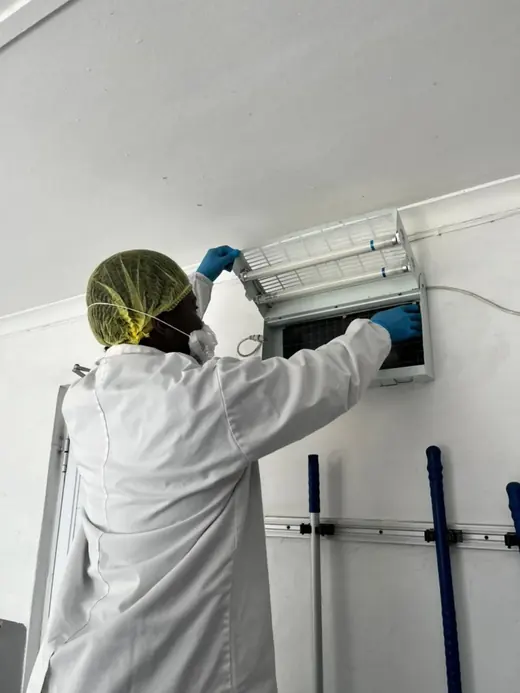
| Place and service insect light traps, count and trend the catches and report recommendations in writing | Contractor |
Virginia Tech advises against pouring bleach down drains, and NC State Extension says bleach and standard cleaners will not kill the larvae. Never mix cleaning chemicals, and do not pour insecticide into a drain. Any treatment on business premises is work for a registered pest control operator, using products registered under Act 36 of 1947 and applied according to the label.
An illustration from a Gqeberha bakery
This is an illustration of a common pattern, not a client case. A bakery in an industrial area of Gqeberha logs small flies near the dispatch area for three weeks running. The light trap counts there climb each week. Killing the adults has not helped.
The technician identifies drain flies on the light trap glue board and tapes the four floor drains overnight. Two drains under the tray washer catch flies. Under the grating, the drain walls carry a thick layer of dough and grease residue that the daily hose-down never reaches.
The bakery adds a weekly scrub of those drains to its cleaning schedule, and staff now sweep up flour and dough scraps before the wet clean so less reaches the drains. Maintenance replaces a cracked drain cover and the contractor adds the drains to the service visit. The catches fall back, and the trend graph and tape results close the corrective action in the pest file.
How this fits a contract
On an ASC contract, fly control is part of the same programme as rodents and crawling insects. Light traps are numbered on a site map in the myASConline portal, catches are identified to species or pest group and trended, and an audit pack is available on demand. Our fly control service covers light traps, drain hygiene advice and drain treatment, and our guide to insect light trap placement explains where traps should go.
Our technicians are employed by ASC, not subcontracted, and work from our Gauteng office at 272 Oak Avenue, Ferndale, Randburg, and our Eastern Cape head office in Gqeberha. See pest control in Gauteng, pest control in the Eastern Cape and the sector pages for food and beverage and hospitality and restaurants. To score your current programme, try the free compliance self-assessment.
Frequently asked questions
Why do drain flies come back after we spray them?
Spraying kills the adults you can see, but the eggs and larvae live in the film inside the drain and keep developing. The flies stop only when the breeding material is scrubbed out and the drain is kept clean on a schedule.
Are drain flies a sign that the kitchen is dirty?
They show that at least one drain or wet area holds organic build-up. Find it with a tape test and clean it to the bottom.
Will an auditor raise a finding for small flies in the production area?
That is for the auditor and the certification body to decide, and nobody can promise the outcome. What the auditor can check is the evidence: whether the source was found and the corrective action closed, with dates.
Does ASC Pest Control treat drain flies in the Eastern Cape and Gauteng?
Yes. Drain and small fly control is part of our fly control service, run from our Eastern Cape head office in Gqeberha and our Gauteng office in Ferndale, Randburg. Call 041 004 0037 or 010 500 4661 to arrange a site assessment.
Have your drains and fly control checked
If small flies keep appearing, start with a no-obligation site assessment. We tape-test the drains and read your light trap trends and pest file before we propose a contract that fits your risk and audit dates. This is what our contract programme does on your site. Request your site assessment, or call 010 500 4661 (Gauteng) or 041 004 0037 (Eastern Cape).
Sources read on 22 November 2026: University of Florida IFAS, Drain fly, Psychoda spp. (IN1226, Gillett-Kaufman and Griffith); NC State Extension, Phorid flies (17 November 2021); Virginia Cooperative Extension, Drain fly (ENTO-414, revised 31 July 2026).