A pest control contract for a restaurant in Gqeberha (Port Elizabeth) or East London should give it scheduled visits by an operator registered under Act 36 of 1947. It should cover monitoring for cockroaches, rodents and flies, written advice on proofing, and a file the health inspector can read in a few minutes. Regulation R638 of 2018 puts the duty on the person in charge of the kitchen.
ASC Pest Control, a SAPCA member (ASC797) with its head office in Gqeberha, offers contract pest control for restaurants, takeaways and franchise groups across the Eastern Cape. It starts with a no-obligation site assessment. Request a site assessment or call 041 004 0037. See contract pest control.
Key points
- Regulation R638 of 2018 requires the premises to be pest proof and the person in charge to take effective measures against pests.
- R638 does not prescribe a pest control contract. Regulation 10(16) does refer to keeping appropriate records, and a contract with service reports is the usual way restaurants keep them.
- What your staff do between visits decides whether a programme works.
Why a restaurant kitchen draws pests
A kitchen is warm, has water at every sink and floor drain, and takes food deliveries most days. In Gqeberha many restaurants sit in older buildings with shared walls and shared service yards, in Richmond Hill and Central, or in centres along the Humewood and Summerstrand beachfront. East London has the same pattern in Vincent, Beacon Bay and along the Esplanade. In a shared building your neighbour's refuse area is part of your pest problem.
A back door propped open through lunch service lets flies in from the bin yard, and a door that does not close flush lets mice in at night. Our article on rats and refuse in Port Elizabeth looks at the pressure from outside.
The pests that matter in a restaurant
| Pest | Where to look | What it tells you |
|---|---|---|
| German cockroach (Blattella germanica) | Behind ovens, fridges and dishwashers, in door seals and motor housings | A breeding population living inside the kitchen, often carried in with boxes and deliveries |
| House fly (Musca domestica) | Refuse area, back door, the pass | A breeding source in refuse nearby and a door or screen that is not keeping flies out |
| Small flies: fruit flies, drain flies and phorid flies | Floor drains, drip trays, under the bar | A film of organic matter that cleaning is not reaching |
| Rodents: house mouse (Mus musculus), roof rat (Rattus rattus) and Norway rat (Rattus norvegicus) | Dry store, ceiling void, refuse yard | A gap in the building and food or shelter within reach |
The German cockroach is the hardest of these to clear from a kitchen. The University of Florida's entomology department records that a typical egg case holds 30 to 40 eggs and that the whole life cycle takes about 100 days, with breeding continuous and generations overlapping. Penn State Extension describes the species as mostly active at night, hiding by day in warm, humid cracks, and notes that they may be seen in daytime when a heavy population is present or the insects are under stress. If staff see them during lunch service, have the kitchen inspected.
Penn State also explains why this matters for food: disease organisms are carried on the legs and bodies of cockroaches and left on food and utensils as they forage. The University of California's pest management programme says house flies lay their eggs in warm, moist organic material such as refuse and can develop from egg to adult in as little as seven days in ideal summer conditions. In summer, a bin that is emptied but never washed can produce a new generation of flies in about a week.
Small flies point to drains. Texas A&M AgriLife Extension notes that drain fly larvae live in the thin film inside drains, and that fruit flies are common in spilled syrup, wine and beer under bars and drink dispensers. For mice, the University of California's house mouse guidance says they can enter through openings as small as a quarter of an inch, about 6 mm. These are species figures from universities abroad, not local surveys.
What Regulation R638 requires of a restaurant
Every restaurant in South Africa works under Regulation R638 of 22 June 2018, made under the Foodstuffs, Cosmetics and Disinfectants Act 54 of 1972. The table summarises, in our own words, the parts that touch pests.
| Regulation | What it requires | Who carries it |
|---|---|---|
| 3(1) and 3(7) | No food may be handled on premises without a valid certificate of acceptability, and the certificate must be displayed where the public can see it. | Person in charge |
| 5(3)(c) | The premises must be pest proof and must have effective means of controlling and preventing the access of flies, cockroaches and other insects. | Person in charge. Structural work may need the landlord, but the duty stays with you |
| 5(3)(d) | Refuse containers must be liquid proof, easy to clean and fitted with close-fitting lids. | Person in charge |
| 10(3) | Effective measures must be taken to prevent or eliminate flies, other insects, rodents, birds, vermin and other pests on the premises. | Person in charge |
| 10(4) and 10(6) | Refuse must be removed as often as necessary, and bins must be cleaned regularly and disinfected when needed. | Person in charge |
Regulation 5(3)(c)(ii) requires pest proofing "in accordance with the best available method". R638 defines that term as a method that is practicable and necessary to protect food, having regard to local conditions, established practice and cost. The regulation does not name a contractor, a service frequency or a pest file, although regulation 10(16) refers to compliance through the keeping of appropriate records.
The consequences sit in regulations 4 and 15. Where an inspector, in practice the municipal environmental health practitioner, is of the opinion that the premises are a health hazard, the local authority may summarily prohibit their use for handling food. A contravention is an offence.
Franchise groups and shopping centre landlords usually add audits of their own, and those tend to ask for what R638 leaves unsaid: a device map, service reports and proof that the operator is registered. Our guide to Act 36 of 1947 explains registration.
Have your pest records checked before the inspector asks for them. ASC Pest Control is a SAPCA member (ASC797) with operators registered under Act 36 of 1947. Request a no-obligation site assessment or call 041 004 0037. Or score your own file with the free audit readiness self-assessment.
What your team does between visits
Your staff are on site every day and the contractor is not. Give each of these checks to a named person.
| Check | How often | Who |
|---|---|---|
| Write every sighting in the sightings log, with date, time and place | When it happens | Any staff member, checked by the manager |
| Pull out mobile equipment and clean underneath and behind | Weekly | Site |
| Empty and wash drip trays, and clean the floor under the bar and drink dispensers | Daily, at close | Site |
| Scrub floor drains, including the inside of the drain | Weekly | Site |
| Empty and wash kitchen bins, and check that lids close | Daily, at close | Site |
| Wash the refuse yard bins and disinfect when needed | At least weekly | Site |
| Check that back doors close flush and are not propped open | Daily | Site |
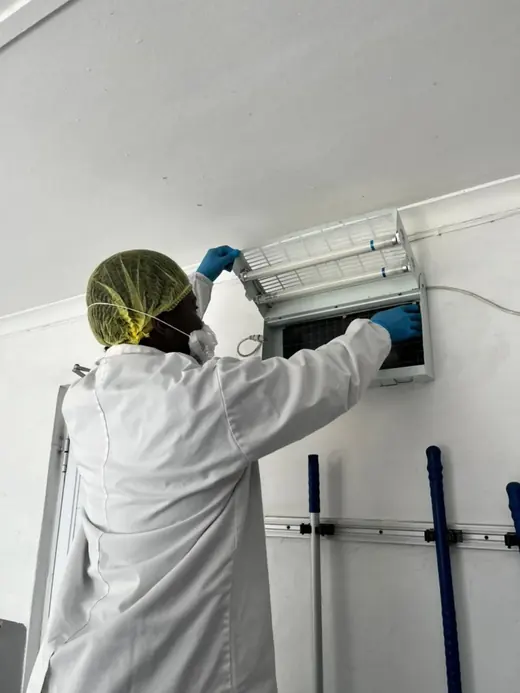
| Inspect and service monitors, bait stations and fly units, and identify what was caught | Every visit | Contractor |
| Report proofing and hygiene faults in writing and follow them up | Every visit | Contractor reports, site fixes |
The free pest identifier helps staff name what they have seen.
An illustration from a busy kitchen
This is an illustration of a common pattern, not a client case. Staff at a 90-seat restaurant in an older Richmond Hill building see cockroaches near the pass during lunch, and the manager asks for a spray. It kills what is visible, and a few weeks later they are back.
A proper response starts with an inspection after service. Sticky monitors go behind the dishwasher and under the pass, and the catches show where the population is densest. It is usually a warm, damp spot such as a dishwasher with a leaking seal. A registered operator then places bait in the cracks where the insects live, away from food. The restaurant fixes the leak, and follow-up visits continue until the monitors stay clear. Each step is written down for the inspector or franchisor. Our article on cockroach management in food facilities covers the method. If that pattern sounds like your kitchen, request a site assessment and we start with that inspection.
What a pest control contract covers in a restaurant
Our contract programme starts with the no-obligation site assessment, inside the building and out. The proposal sets out the devices, the visit schedule and the proofing work we recommend. Visits are planned around your service times.
Every device is numbered and shown on a device map. After every visit the report goes onto the myASConline portal, where you can see trend analysis and draw an audit pack on demand.
The technicians are employed by ASC, not subcontracted, and the company is owned by accredited food safety specialists. Our Eastern Cape head office is in Gqeberha. We have no branch in East London, and restaurants there are serviced on scheduled routes from Gqeberha. See pest control in Port Elizabeth, pest control in East London and pest control for restaurants and hotels.
For Gauteng, see hospitality pest control in Gauteng or call 010 500 4661.
Frequently asked questions
Is pest control a legal requirement for restaurants in South Africa?
Yes, although the law does not mention a contract. Regulation R638 of 2018 requires the premises to be pest proof and the person in charge to take effective measures to prevent or eliminate pests. A contract with a registered operator and service reports is the usual way to show an inspector that this is being done.
Can a health inspector close a restaurant because of pests?
Regulation 4 of R638 allows the local authority to summarily prohibit the use of food premises where an inspector is of the opinion that their condition is a health hazard. After putting the fault right, the person in charge may ask in writing for the order to be removed. An inspector must investigate within 72 working hours, and the local authority then confirms in writing whether the order is withdrawn or stays in force.
How often should a restaurant have pest control?
R638 does not fix a number of visits. Many restaurant kitchens are serviced monthly, with extra visits while an infestation is being cleared. We set the frequency for each site after the assessment, based on the building and its pest history.
Does ASC Pest Control service restaurants in East London?
Yes. We have no branch in East London, so restaurants there are serviced on scheduled routes from our head office in Gqeberha. Call 041 004 0037 to arrange a site assessment.
Request a site assessment in Gqeberha or East London
Changing contractor does not mean starting again, because serviceable devices can stay where they are. We walk the kitchen with you at a time that suits your service and tell you plainly what we find. The proposal follows, with no obligation. Request your site assessment or call 041 004 0037.