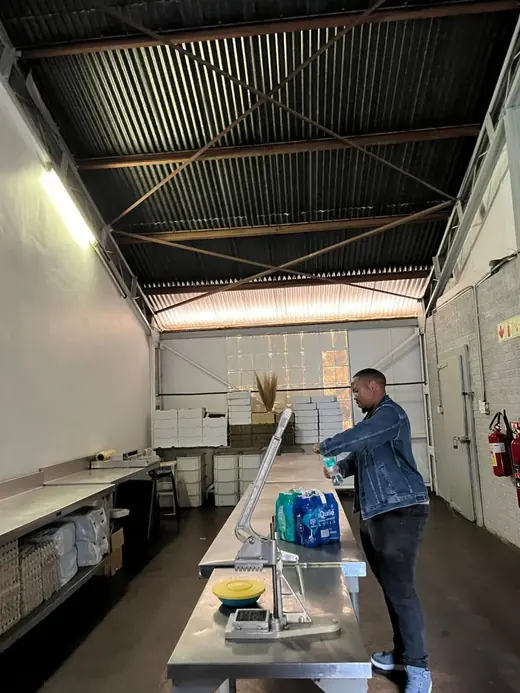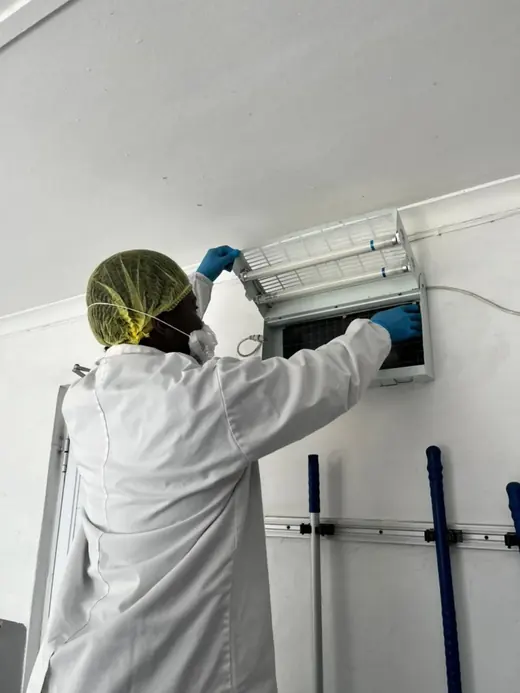
The BRCGS Storage and Distribution pest control requirements are in section 6.6, pest management, of Issue 4 of the Global Standard. Its ten clauses make the company responsible for minimising the risk of pest infestation on the site. The auditor looks for staff who can recognise and report pest signs, a competent contractor or trained in-house team, an inspection frequency set by a documented risk assessment and a complete pest file. Two things must happen at least once a year: a review of the results for trends, and an in-depth survey by a pest control expert.
This guide is for whoever signs or manages the pest control contract at a warehouse, cold store, distribution centre or third party logistics site in South Africa. We work in Gauteng and the Eastern Cape. The clauses below are what our contract programme is built to answer on your site. To see how yours measures up, request a no-obligation site assessment for a pest control contract.
Key points
- Pest management is section 6.6 of Issue 4, clauses 6.6.1 to 6.6.10. The company is responsible for the outcome, even when a contractor does the work.
- The Standard sets no number of visits. Frequency comes from a documented risk assessment.
- Pests are also audited outside section 6.6, in the clauses on the building, vehicles, waste and goods receiving.
Which edition applies
Issue 4 is the issue in use. The BRCGS page for the Standard gives its publication date as 11 October 2020. It is read together with the BRCGS position statements for Issue 4, which are mandatory from their effective dates. The current version, 8.2, is dated 6 October 2026. Its newest statements, added in version 8 of 27 April 2026, apply from 10 August 2026.
Position Statement 13 amends clause 2.1 on prerequisite programmes. Pest management procedures stay on the list of prerequisites, and the company must document their control measures and monitoring and include them when the hazard and risk analysis (the HARA or HACCP plan) is developed and reviewed. Your pest programme is therefore part of that plan as well as the contractor's folder.
The clause numbers in this guide were read on 20 November 2026 in the BRCGS site self-assessment tool for Issue 4 (document SD401) and in the position statements (document SD404). The wording below is our paraphrase, so check it against your own copy of the Standard.
Section 6.6 pest management requirements, clause by clause
| Clause | What it asks for | Who |
|---|---|---|
| 6.6.1 | Employees understand the signs of pest activity and report any evidence to a designated manager. | Site |
| 6.6.2 | Products are stored so that the risk of infestation is kept low. Where stored product pests are a risk, the control programme includes measures for them. | Both |
| 6.6.3 | When pest activity is found, the site acts at once to identify the products at risk and limit contamination. Affected stock goes through the non-conforming product procedure and the infestation is recorded. | Both |
| 6.6.4 | A competent pest control organisation is contracted, or trained staff do the work, for regular inspection and treatment. Frequency is set by a documented risk assessment, reviewed when buildings or processes change or after a significant pest issue. The service meets the law. | Both |
| 6.6.5 | Where a contractor is used, the service contract is clearly defined and reflects the activities of the site. | Both |
| 6.6.6 | The records include an up-to-date site plan showing the pest control devices, identification of the baits and monitoring devices, the responsibilities of site management and of the contractor, the products used and what to do in an emergency, the pest activity observed and the treatments done. Paper or electronic records are accepted. | Contractor, checked by the site |
| 6.6.7 | A site that does its own pest management shows trained and competent staff, legally required training or registration, enough resources, access to specialist knowledge, compliance with pesticide law and a dedicated locked pesticide store. | Site |
| 6.6.8 | Inspection results, including trapping and monitoring data, are analysed for trends at least once a year or after an infestation, and the analysis is used to improve the programme. | Both |
| 6.6.9 | Records are kept of inspections, proofing and hygiene recommendations and the actions taken. The site makes sure recommendations are documented and carried out in good time. | Both |
| 6.6.10 | A pest control expert carries out an in-depth documented survey at least once a year, at a frequency based on risk. It looks for pest activity, advises on long-held stock and reviews the measures in place. It is timed to allow access to equipment for inspection where stored product insects are a risk. | Contractor |
Where else the auditor meets pests
Clause 3.5.1.1 lists pest control among the services that fall under supplier approval, so the contractor is approved and reviewed like any other service provider. Clause 4.1.3 asks that the building fabric is maintained to keep pest entry to a minimum, for example by sealing the gaps around pipes, and that a clean, unobstructed strip is kept along the external walls of buildings used to store products.
Clause 4.4.9 is the proofing clause: "Buildings shall be suitably proofed against the entry of all pests." It goes on to list, as appropriate, window screens, close-fitting or proofed external doors, precautions when storage doors stand open, screens and traps on drains, and protection of canopies against roosting and nesting birds. Our guide to rodent proofing and exclusion shows what that means at a dock door.
Under clause 5.1.4, the check before loading confirms that the vehicle shows no evidence of pests. Clause 6.5.2 asks that external waste containers and compactors hold their contents and do not attract pests.
At goods receiving, clause 7.1.2 asks that incoming loads are inspected so that products are free from pest infestation, contamination and damage. Clause 4.4.7 asks that bulbs and strip lights that could break are protected, including those on electric fly killer units.
Audit date in the diary? ASC Pest Control is a SAPCA member (ASC797) with operators registered under Act 36 of 1947, and is owned by accredited food safety specialists. Request a no-obligation site assessment, or call 010 500 4661 in Gauteng or 041 004 0037 in the Eastern Cape, weekdays 08:00 to 17:00.
What the site does and what the contractor does
The statement of intent for section 6.6 puts the responsibility on the company. Expect the auditor to ask a forklift driver what they do when they see droppings.
The site does the daily work. That means training staff on pest signs, keeping stock off the walls and moving in date order, cleaning up spillage, keeping dock doors closed, and having the proofing repairs done.
The contractor brings the technical work: the risk assessment that sets the visit frequency, the numbered devices and the plan that shows them, identification of what is caught to species or pest group, treatment by registered operators using products registered under Act 36 of 1947, the trend review and the yearly in-depth survey. See our guides to trend analysis and the risk assessment.
An illustration from a Gauteng warehouse
This is an illustration of a common pattern, not a client case. Take a third party logistics warehouse in Isando that stores bagged maize meal, flour and pet food for several owners, six weeks before its BRCGS audit.
A pre-audit walk finds three gaps. The device plan still shows the racking layout from before an extension, so twelve stations in the new bay are not on it (6.6.6), and the risk assessment was not reviewed after that change (6.6.4). The last in-depth survey was fourteen months ago and never reached the long-held pet food at the back of the top racking level (6.6.10). Two proofing recommendations about a dock leveller, raised in three service reports in a row, have no action recorded against them (6.6.9, 4.4.9).
An auditor could raise all three, and all three can be closed in six weeks: redraw the plan, renumber the devices and review the risk assessment, book the survey with access to the top level, fit the leveller seals and sign the actions off. Our stored product insects guide covers the stock side.
How a contract programme answers section 6.6
An ASC contract starts with a site survey. Visit frequency is set per area from the risk assessment and written into the contract (6.6.4, 6.6.5). Every device is numbered and plotted on a site map in the myASConline portal, with trend analysis and an audit pack on demand (6.6.6, 6.6.8).
Recommendations are logged as corrective actions, so both parties can see what is open (6.6.9). The yearly in-depth survey by a pest control expert (6.6.10) is a standard part of the contract, timed around your stock levels and audit date.
Our technicians are employed by ASC, not subcontracted. If you are changing contractor, serviceable devices already on site can be kept and renumbered. We work from our Gauteng office at 272 Oak Avenue, Ferndale, Randburg, and our Eastern Cape head office in Gqeberha. There is no branch in East London, which we service from Gqeberha.
See pest control for warehousing and logistics, pest control in Gauteng and pest control in the Eastern Cape. For open food sites, read the BRCGS Food Safety guide. For a quick score of your current programme, try the free compliance self-assessment.
Frequently asked questions
Which part of BRCGS Storage and Distribution covers pest control?
Section 6.6, pest management, clauses 6.6.1 to 6.6.10, in Issue 4 of the Standard. Pests also come up in the clauses on prerequisite programmes, supplier approval, building fabric and proofing, vehicles, waste and the receipt of goods.
How often must a warehouse be inspected for pests under BRCGS Storage and Distribution?
The Standard does not set a number of visits. The frequency of inspection comes from a documented risk assessment, which is reviewed when the building or the processes change or after a significant pest issue. On top of the routine visits there is an in-depth survey by a pest control expert, and a review of the results for trends, each at least once a year.
Can a warehouse do its own pest control under BRCGS Storage and Distribution?
The Standard allows it, on conditions. The site must show trained and competent staff, any training or registration the law requires, enough resources, access to specialist knowledge, compliance with pesticide law and a dedicated locked store for pesticides. In South Africa, Act 36 of 1947 allows an agricultural remedy to be used in the course of a business only by a pest control operator registered under the Act, or in the presence and under the supervision of one. Many sites therefore keep the daily checks in-house and contract the treatment work.
Does a good pest control contractor mean we will pass the audit?
No. The certification body decides the audit result, and the Standard makes the company responsible for minimising the risk of infestation. A contractor's part is to keep the programme working and the records complete.
Have your programme checked against section 6.6
Already have a contractor? A no-obligation site assessment shows where your current file stands against section 6.6. We walk the site, read your pest file, and propose a contract that fits your risk and your audit date. Request your site assessment, or call 010 500 4661 (Gauteng) or 041 004 0037 (Eastern Cape).