A food packaging factory in Gauteng needs a contract pest control programme that covers the whole site and is run by a registered pest control operator, with records that your customers and your certification auditor can follow. A moth sealed into a laminate, or rodent droppings in a pallet of cartons, becomes your customer's contamination complaint, and the investigation ends at your dispatch bay.
ASC Pest Control, a SAPCA member (ASC797), offers contract pest control for packaging and printing plants from our Gauteng office in Randburg. The first step is a no-obligation site assessment. We walk the plant with your current pest file and tell you where it would stand against your standard. Request a site assessment or call 010 500 4661. See contract pest control.
Key points
- Paper, board, starch adhesive and wooden pallets feed and shelter pests, and dock doors that stand open through a night shift let them in.
- BRCGS Global Standard Packaging Materials Issue 7 deals with pest management in section 4.11, which has nine clauses.
- FSSC 22000 Version 7 was published in May 2026. It moves the scheme's prerequisite programmes to the ISO 22002:2025 series, and pest control is clause 7 in both ISO 22002-100:2025 and ISO 22002-4:2025.
- No contractor can promise you a certificate. A contractor can run the programme properly and keep the evidence in order.
Why a packaging plant attracts pests
Managers in packaging often say there is nothing in the plant for a pest to eat. There is more than it seems. Corrugated board is glued with starch-based adhesive, so the starch store and the glue kitchen can feed rodents, cockroaches and stored product insects. Reels of paper and stacks of board are dry nesting material that nobody moves for weeks, and wooden pallets arrive from other people's yards.
Plants in Ekurhuleni (Wadeville, Alrode, Isando, Springs) and in Rosslyn, Tshwane, commonly run long shifts with dock doors open for reel deliveries and dispatch. A lit doorway draws night-flying insects after dark.
Damp is the other factor. Psocids, often called booklice, are tiny insects that feed on mould and need moisture or high humidity. Utah State University Extension lists cardboard boxes among the places they are found indoors and treats them as a sign of a moisture problem. A customer who opens a pallet and finds live insects on the cartons will reject it, whatever the insect is.
The pests that matter in a packaging plant
| Pest | Where to look | What it does |
|---|---|---|
| Rodents: house mouse (Mus musculus), roof rat (Rattus rattus) and Norway rat (Rattus norvegicus) | Reel and board stores, pallet stacks, under dock levellers, the starch store | Gnawed reels and cartons, droppings on stock |
| Feral pigeons (Columba livia) and other birds | Loading canopies, roof steelwork, high racking | Droppings and feathers on finished goods and pallets |
| Night-flying insects such as moths and midges | Open doors, lights, print and lamination lines | Insects caught in ink or adhesive, or sealed between layers of laminate |
| Cockroaches | Canteen, change rooms, drains, the glue kitchen | Droppings and insects in finished packs |
| Stored product insects | Starch and other dry raw materials | Breed in the raw material and spread to stock stored nearby |
| Psocids (booklice) | Damp board and paper, pallets, anywhere near a leak | Live insects on stock, and a sign of damp |
What BRCGS Packaging Materials Issue 7 asks for
Gauteng converters that hold BRCGS certification usually do so because their retail and brand customers ask for it. The current issue is the Global Standard Packaging Materials Issue 7 (2024). Pest management is section 4.11. The table summarises the nine clauses in our own words, checked against the BRCGS auditor checklist and site self-assessment tool for Issue 7 (Word document).
| Clause | What it asks for | Who |
|---|---|---|
| 4.11.1 | A preventive programme for every area the site controls, checked against seasonal changes in pest activity. | Site and contractor |
| 4.11.2 | A competent contractor or trained in-house staff, a clearly defined service contract, and an inspection frequency set by a documented risk assessment. | Site |
| 4.11.3 | Where the site does its own pest control, trained and legally registered people with access to specialist advice. | Site |
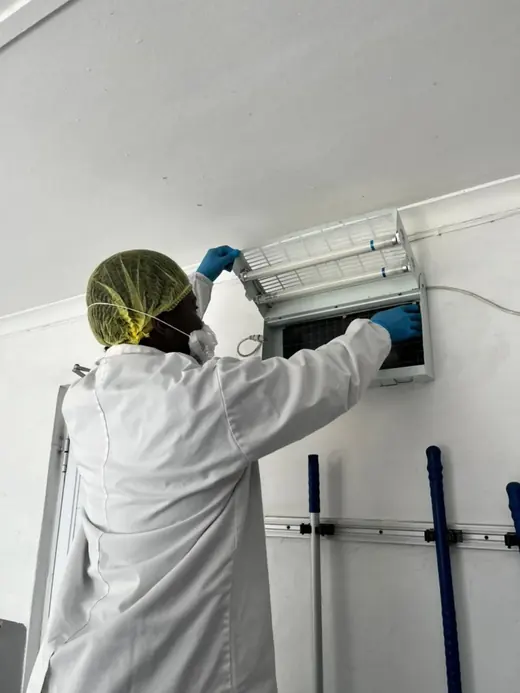
| 4.11.4 | Bait stations, traps and electric fly killers correctly placed and working. Pest control products kept on site locked in a dedicated store. | Contractor and site |
| 4.11.5 | Proofing of doors, windows, ducts, drains and cable entries. Birds and bats kept from entering or roosting above loading areas. | Site, on the contractor's report |
| 4.11.6 | Immediate action on an infestation and a decision on any affected product. | Site and contractor |
| 4.11.7 | Catch analysis from flying insect devices at suitable intervals, and a risk assessment where activity rises. | Site requests it, contractor supplies it |
| 4.11.8 | A signed, current site plan with numbered devices, the responsibilities of site and contractor, details of the products used, and inspection and infestation records. Contractor recommendations acted on in time and checked for effect. | Site and contractor |
| 4.11.9 | Staff who can recognise the signs of pests and know whom to tell. | Site |
Two other clauses belong in the pest file. Clause 5.7.2 asks for incoming goods to be inspected on arrival for pests, contamination and damage. Clause 4.10.6 asks for external waste storage that keeps pest harbourage to a minimum. A BRCGS position statement that took effect on 10 August 2026 amended clauses 4.4.1 and 4.8.2 of Issue 7 and left section 4.11 as it was.
What FSSC 22000 and ISO 22002-4 ask for
Other plants are certified to FSSC 22000 under its packaging category. The Foundation published Version 7 of the scheme in May 2026. According to FSSC's own summary of the changes, audits against Version 6 are permitted until 30 April 2027, and upgrade audits against Version 7 run from 1 May 2027 to 30 April 2028.
Version 7 replaces the older ISO/TS 22002 documents with the ISO 22002:2025 series. For a packaging plant that means ISO 22002-100:2025 read together with ISO 22002-4:2025 for food packaging manufacturing. ISO 22002-4:2025 replaced ISO/TS 22002-4:2013. Pest control is clause 7 in both documents. If your next audit is still on Version 6, ask your certification body which prerequisite document applies on your audit date.
South African food hygiene law comes into it through your customers. Regulation R638 of 2018, made under the Foodstuffs, Cosmetics and Disinfectants Act 54 of 1972, is written for food premises, the places where food is handled. Regulation 10(3) requires the person in charge there to ensure that effective measures are taken to prevent or eliminate pests. Your customers carry that duty, which is why their supplier questionnaires ask about your pest control.
Not sure how your pest file would stand up? ASC Pest Control is a SAPCA member (ASC797) with operators registered under Act 36 of 1947. Request a no-obligation site assessment or call 010 500 4661. You can also score your file first with the free audit readiness self-assessment.
Where to look on your own site
Start at goods-in. Inspect incoming pallets and reels on the dock, as your intake procedure sets out, before they go into the store, and record the check. In the reel and board store, keep stock away from the walls so that someone can walk the perimeter with a torch. In the starch store and glue kitchen, vacuum up spilt starch powder often and do not hose it into the drains. At the corrugator, clear adhesive drips and dried crust from around the glue pans. On the print and converting floor, look at where the insect light traps hang. A trap that can be seen from the yard through an open door draws insects into the building. Do not hang one directly above an open web. Our guide to insect light trap placement explains the rules. Outside, look at the baler yard and any light fixed directly above a door.
An illustration from a flexible packaging plant
This is an illustration of a common pattern, not a client case. Take a flexible packaging plant in Wadeville that prints and laminates film for snack foods and runs a night shift. In November a customer returns a reel with a small moth sealed between two layers of laminate. The pest file shows monthly visits and a tick against each insect light trap, with no count of what the traps caught and no identification.
A proper investigation starts with the traps. The catch in each unit is counted and identified to species or pest group. That shows the two traps nearest the reel door carrying most of the catch, nearly all of it night-flying moths from outside. The cause is the reel door standing open through the night shift under a floodlight fixed above it. The night shift gets a door rule and the floodlight moves to a pole that lights the door from a distance. No insecticide is involved, and a monthly catch trend gives the auditor the catch analysis that clause 4.11.7 asks for.
What a pest control contract covers on a packaging site
Our contract programme starts with a no-obligation site survey and a written risk assessment that sets the visit frequency for each area. The devices go onto a numbered map. Each visit is recorded in the myASConline portal, with catches identified to species or pest group, trend analysis and an audit pack on demand.
The technicians are employed by ASC, not subcontracted, and the operators are registered under Act 36 of 1947. ASC is owned by accredited food safety specialists, so the programme is built around what an auditor asks to see. We work from 272 Oak Avenue, Ferndale, Randburg, Monday to Friday, 08:00 to 17:00. See pest control in Gauteng, pest control in Ekurhuleni and manufacturing pest control, or our guide to pest control tender specifications if you are going out to tender.
Packaging plants in the Eastern Cape get the same programme from our head office in Gqeberha, on 041 004 0037.
Frequently asked questions
Does a food packaging factory need pest control if it does not handle food?
Yes. Your packaging goes straight onto a customer's food line. BRCGS Packaging Materials Issue 7 and FSSC 22000 both include pest management, and food customers ask for evidence of it.
Which part of BRCGS Packaging Materials covers pest control?
Section 4.11 of BRCGS Global Standard Packaging Materials Issue 7 covers pest management, in clauses 4.11.1 to 4.11.9. Clause 5.7.2 on inspecting incoming goods and clause 4.10.6 on external waste storage also refer to pests.
How often should pest control service a food packaging plant?
BRCGS Packaging Materials Issue 7 gives no fixed number of visits. Clause 4.11.2 asks for the inspection frequency to be set by a documented risk assessment and reviewed when the building or process changes, or after a significant pest problem. We propose a frequency for each area after the site assessment.
Request a site assessment for your plant
Changing contractor does not mean starting again, because serviceable devices already on site can be kept and renumbered. The site assessment commits you to nothing. We walk the plant from goods-in to dispatch with your pest file in hand, whoever services the site now, and then send a proposal. Request your site assessment or call 010 500 4661.