The German cockroach (Blattella germanica) is the small, tan to dark brown cockroach with two dark stripes behind its head that lives inside warm kitchen equipment. It arrives in deliveries, boxes and second-hand equipment, hides in cracks close to food and water, and can breed all year in a heated kitchen. If your staff see one in daylight, expect many more behind the equipment and act that day.
This guide is for the owner, general manager, executive chef or food safety manager of a restaurant, franchise group, hotel, guesthouse or caterer in Gauteng or the Eastern Cape. Finding the hiding places, baiting them and trending the monitor catches to show whether the numbers are falling is what our contract programme does on your site. To have your kitchen checked, request a no-obligation site assessment for a pest control contract.
Key points
- Look for two dark parallel stripes on the shield behind the head, on a tan to dark brown cockroach 10 to 16 mm long.
- NC State Extension gives an average of 40 eggs in each egg case and five to eight egg cases in a female's life.
- Regulation R638 of 2018 names cockroaches: food premises must be provided with effective means of controlling and preventing the access of flies, cockroaches or other insects.
How to recognise a German cockroach
NC State Extension describes the adult as 13 to 16 mm long, dark brown to tan and winged, with two dark parallel stripes on the pronotum, the shield that covers the back of the head. The University of Florida's Featured Creatures profile gives 10 to 15 mm. Both describe the stripes, and the stripes are what your staff should learn.
The young, called nymphs, start at about 3 mm according to NC State. The University of Florida describes them as dark brown to black and wingless, with the same dark bands.
The female carries her egg case, the ootheca, at the tip of her abdomen until just before the eggs hatch.
The other cockroach kitchens meet is the American cockroach (Periplaneta americana), which is much larger, reddish brown and comes up from drains and service ducts. It is treated differently, so keep a specimen on a sticky trap for your technician, or try our free pest identifier. Our guide to cockroach management in food facilities compares the species side by side.
The signs to look for
| Sign | Where to look | What it tells you |
|---|---|---|
| Clusters of tiny brown to black dots (faecal spots) | Door hinges, shelf brackets, the corners of cupboards, behind wall-mounted equipment | A hiding place is close by. Clean the spots off and check whether new ones appear. |
| Live cockroaches when the lights go on | Under the pass, around dishwashers, fridge motors and coffee machines | An active population. They feed at night. |
| Cockroaches seen by day | Anywhere in the open | The hiding places are crowded. The population is likely to be large. |
| Egg cases and shed skins | Inside equipment housings, drawer runners and hollow table legs | They are breeding on site. |
| A distinct, persistent odour | Closed cupboards and equipment voids | NC State links the odour to heavy infestation. |
Life cycle and why the numbers climb
NC State Extension reports an average of 40 eggs in each egg case, and the University of Florida gives 30 to 40. A female usually produces five to eight cases, or 200 to 250 eggs in her life, and adult females live 140 to 280 days. NC State gives 70 to 100 days for the cycle, made up of 20 to 30 days in the egg case, 40 to 60 days as a nymph and 6 to 10 days of mating and egg production, and says the species thrives at about 25 to 30°C.
The biology, resistance and bait findings in this guide come from US university extension publications. We have found no published South African figures for commercial kitchens.
The University of Florida profile adds two facts that explain why this pest is so hard to see. Actively growing field populations are about 80% nymphs and 20% adults, so the adults your staff notice are the smaller part of what is there. It also says the species cannot survive away from human activity and that cold is its main limit. A working kitchen in Johannesburg or Gqeberha stays warm through winter, which is our reading of why activity does not stop in July in either province.
Where German cockroaches hide in a restaurant kitchen
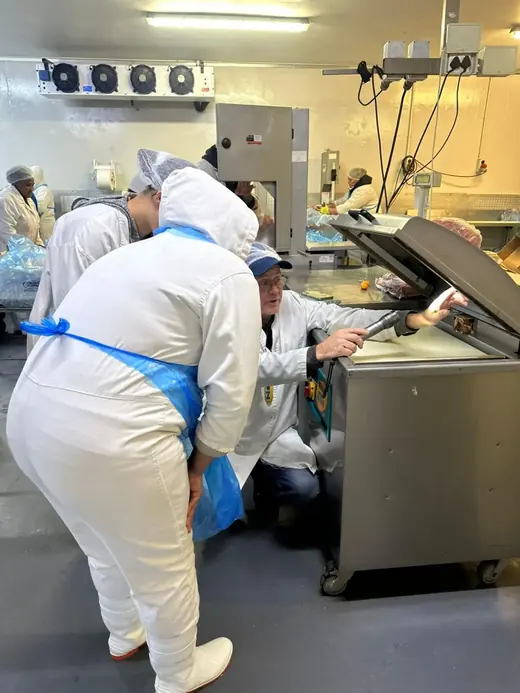
German cockroaches gather in tight, dark, warm places close to food and water. The University of Florida's guide to assessment-based management tells inspectors to check where heat is generated: behind fridges and freezers, ovens and stoves, and in electrical junction boxes. It also lists unsealed pipe collars under sinks, the edges of wall-mounted panels and hollow-legged tables.
In a restaurant or hotel that means the dishwash area, the bain-marie and hot pass, under-counter fridges, the bar and the coffee station. In a hotel, add room service pantries, the banqueting kitchen and minibar fridges. The same guide says cockroaches thrive in cardboard and advises removing it.
What it means for food safety and the law
NC State Extension states that German cockroaches mechanically carry disease organisms they pick up in the environment, and names Salmonella. NC State adds that their droppings, saliva, eggs and shed skins carry allergens linked to asthma.
We read the Regulations Governing General Hygiene Requirements for Food Premises, the Transport of Food and Related Matters (Government Notice R638, Government Gazette 41730 of 22 June 2018) on 25 November 2026.
Regulation 5(3)(c)(ii) requires food premises to be pest proof in accordance with the best available method. Regulation 5(3)(c)(iii) requires them to be provided with effective means of controlling and preventing the access of flies, cockroaches or other insects.
Regulation 10(3) requires the person in charge to ensure that "effective measures" are taken to prevent or eliminate insects and other pests on the food premises. That duty stays with the owner or responsible manager. A contractor helps you meet it but does not take it over. See our guide to R638.
A small striped cockroach in your kitchen needs checking. ASC Pest Control is a SAPCA member (ASC797) with operators registered under Act 36 of 1947, and is owned by accredited food safety specialists. Request a no-obligation site assessment, or call 010 500 4661 in Gauteng or 041 004 0037 in the Eastern Cape, weekdays 08:00 to 17:00.
How it gets into a clean kitchen
The University of Florida guide says German cockroaches do not come into buildings from outdoors. People carry them in. NC State lists furniture, grocery products and shipments of goods as the usual carriers, and adds that small nymphs are easy to miss.
For a food business the likely routes are supplier crates and boxes, second-hand or returned equipment, hired catering equipment, and staff bags and lockers. In a shopping centre or hotel they also move between tenants through shared walls and service ducts.
What the site does and what the contractor does
| Task | Who |
|---|---|
| Clean under and around equipment nightly, and pull movable equipment out on a deep-clean schedule | Site |
| Empty food waste before closing and leave no dirty dishes or standing water overnight | Site |
| Unpack deliveries away from the kitchen and send cardboard out the same day | Site |
| Log every sighting: place, time, date, who saw it and what was done | Site |
| Repair leaks and seal gaps around pipes, panels and fixed equipment | Site (maintenance) |
| Inspect, identify the catch to species or pest group and find the hiding places | Contractor |
| Place numbered sticky monitors, trend the catches and report in writing | Contractor |
| Apply registered baits into cracks and voids, and change the bait type when catches stop falling | Contractor |
| Read each service report, carry out the recommendations and sign them off | Site |
NC State's management guide explains why spraying open surfaces is the wrong answer. Sprays give a quick but temporary knockdown and can repel and scatter the cockroaches, and foggers do not get into the places where they hide. Baits work because cockroaches feed on each other's droppings and on their dead, which carries the bait to the youngest nymphs, which mostly stay hidden in the cracks. Ask your technician where bait has been placed, and keep water and cleaning chemicals off those points.
The same guide reports that resistant populations have been recorded for every class of insecticide used since the 1950s, and that some populations have developed an aversion to glucose, the sugar used in many baits. If the trap counts stop falling, the operator changes the approach. Any treatment on business premises is work for a registered pest control operator, using products registered under Act 36 of 1947 and applied according to the label.
An illustration from a Pretoria restaurant
This is an illustration of a common pattern, not a client case. A restaurant in a shopping centre in Pretoria East logs two small cockroaches at the coffee station in one week. The area is sprayed and the sightings stop for a few days, then start again at the dishwash area.
The technician identifies them as German cockroaches and places numbered sticky monitors along the walls and beside the warm equipment. A week later the monitor under the coffee machine holds adults and nymphs of every size. The University of Florida guide reads all life stages on a monitor as an established infestation, and advises searching within 5 to 10 feet, about 1.5 to 3 m, of a monitor that holds young nymphs. One to a few adults alone would point to a new introduction. The source turns out to be the motor housing of an under-counter fridge bought second-hand three months earlier.
The restaurant has the fridge pulled out and cleaned and the pipe collars behind the counter sealed. Milk is now unpacked at receiving and taken straight to the fridge, and the crates stay out of the kitchen. The contractor baits the housing and the cracks around it and checks the monitors weekly. Once the counts have fallen and stayed down, the manager signs off the corrective action in the pest file, with the trend graph as the evidence. Second-hand equipment is now inspected before it enters the kitchen.
How this fits a contract
On an ASC contract, cockroach monitors are numbered on a site map in the myASConline portal, catches are identified to species or pest group and trended, and an audit pack is available on demand. Our cockroach control service is built on inspection, sticky monitors, targeted gel baiting and work on the hiding places.
Our technicians are employed by ASC, not subcontracted, and work from our Gauteng office at 272 Oak Avenue, Ferndale, Randburg, and our Eastern Cape head office in Gqeberha. See pest control in Pretoria, pest control in Gauteng, pest control in the Eastern Cape and the sector page for hospitality and restaurants. Related guides cover restaurants in Gqeberha and East London and hotels in Sandton and Pretoria. To score your current programme, try the free compliance self-assessment.
Frequently asked questions
How do I know it is a German cockroach and not another kind?
Look for two dark parallel stripes on the shield behind the head, on a tan to dark brown cockroach 10 to 16 mm long that lives in and around warm equipment. A much larger reddish brown cockroach near drains is more likely to be an American cockroach.
We saw one cockroach in the kitchen. Is that a problem?
Treat it as one. German cockroaches hide by day and most of the population is young and out of sight, so one sighting in daylight usually means more are close by. Log it and have the area inspected.
Why do cockroaches come back after spraying?
Sprays kill the cockroaches they touch and can scatter the rest to other parts of the building, while the egg cases and the young in the hiding places are not reached. The numbers stay down only when the hiding places are found, cleaned and baited, and the monitors show that the catches have stopped.
Does ASC Pest Control treat German cockroaches in Gauteng and the Eastern Cape?
Yes. Cockroach control is part of our contract service for restaurants, hotels and food businesses, run from our Gauteng office in Ferndale, Randburg, and our Eastern Cape head office in Gqeberha. Request a no-obligation site assessment on this page, or call 010 500 4661 (Gauteng) or 041 004 0037 (Eastern Cape).
Have your kitchen checked
If your staff have seen a small striped cockroach, start with a no-obligation site assessment. We inspect the warm equipment and the receiving area and read your pest file before we propose a contract that fits your kitchen. From there, the inspection, monitoring and baiting described above run as our contract programme on your site, carried out by ASC's own registered operators. Request your site assessment, or call 010 500 4661 (Gauteng) or 041 004 0037 (Eastern Cape).
Sources read on 25 November 2026: NC State Extension, Biology and behavior of the German cockroach (Wada-Katsumata and Hayes, 23 January 2025) and German cockroach surveillance and management (Alder and Hayes, 23 January 2025). University of Florida IFAS, German cockroach, Blattella germanica (EENY-002, Valles) and Assessment-based pest management of German cockroaches (Oi, Weeks, Jonovich and Miller).